ENJJPT – Forging NATO's Future Aviators
Inside the Euro-NATO Joint Jet Pilot Training Program
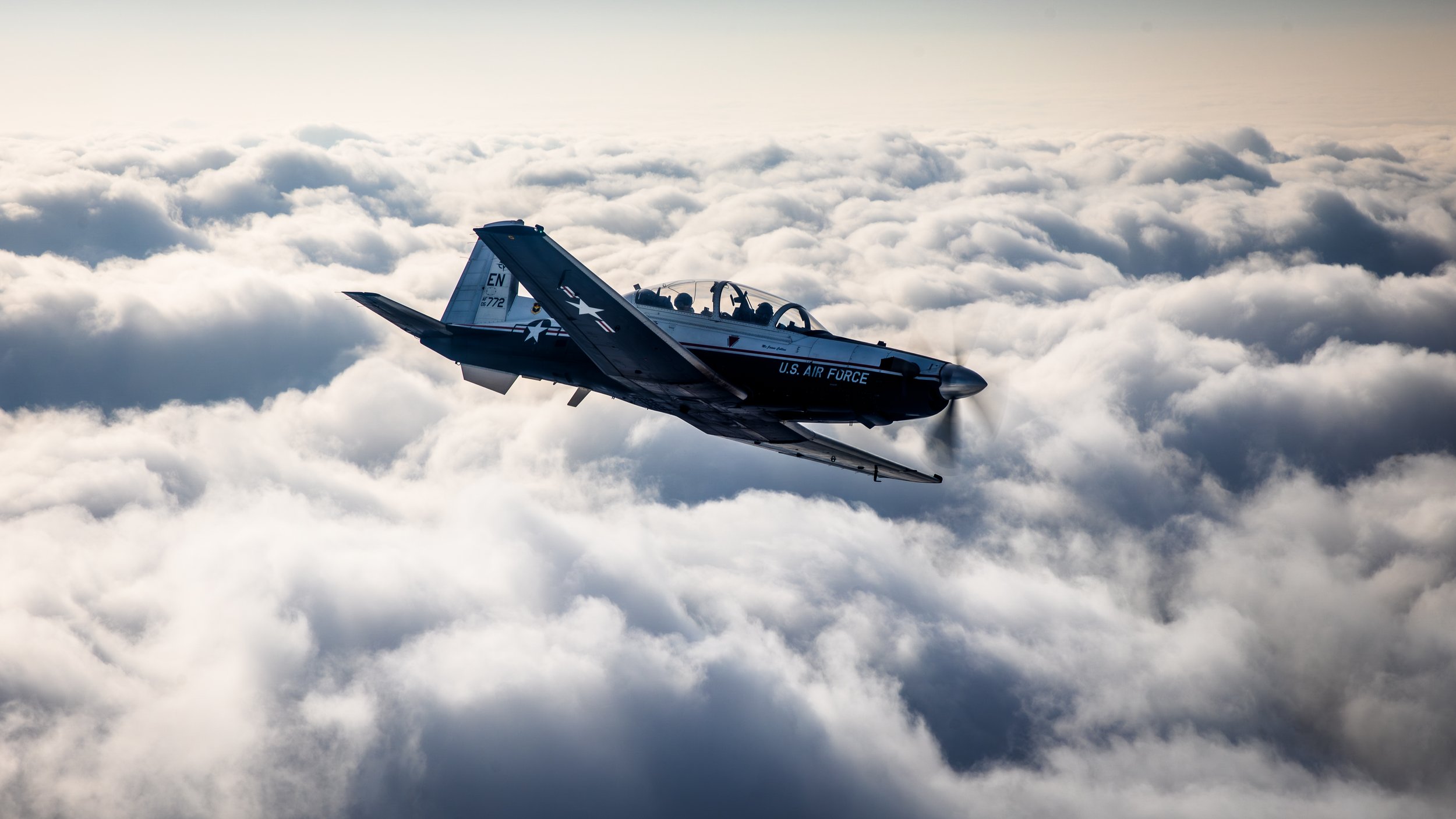
"The journey to becoming a fighter pilot does not begin with afterburners or supersonic flight. It begins with discipline, preparation, and a shared commitment to excellence."
The World's Only Multinational Fighter Pilot School
Modern air warfare depends on interoperability. Whether conducting NATO Air Policing missions over the Baltic States, participating in large-scale exercises such as Red Flag or Ramstein Flag, or responding to real-world operations, fighter pilots rarely fly as isolated national assets. Success increasingly depends on the ability of allied air forces to operate as a single, integrated force.
That level of cooperation does not begin on deployment. It begins in training.
For more than four decades, the Euro-NATO Joint Jet Pilot Training (ENJJPT) Program, based at Sheppard Air Force Base in Wichita Falls, Texas, has provided a unique answer to that challenge. Established in 1981, it remains the only multinational military flying training programme in the world in which NATO nations collectively train future fighter pilots under a common syllabus. While participating air forces retain responsibility for selecting their own candidates and operating their frontline aircraft, ENJJPT provides the advanced flying instruction that forms the foundation of thousands of military aviation careers.
Its graduates have gone on to fly aircraft including the F-16 Fighting Falcon, Eurofighter Typhoon, Dassault Rafale, F-15 Eagle, Panavia Tornado and, increasingly, the F-35 Lightning II. Although these aircraft differ significantly in capability and national employment, the pilots flying them share a common professional foundation established during their time at ENJJPT.
That shared foundation is perhaps the programme's greatest achievement.
Coalition air operations rely on more than compatible aircraft and communications systems. They require common procedures, mutual trust and confidence that every pilot in a formation has been trained to comparable standards. Those qualities cannot be developed during a multinational exercise alone. They are built over months of instruction, shared experiences and a common understanding of military aviation.
ENJJPT was created to provide exactly that environment.
Today, fourteen NATO nations contribute instructors, leadership and resources to the programme, making it one of the Alliance's most enduring examples of practical defence cooperation. Students train together from the earliest stages of their flying careers, learning not only how to operate military aircraft but also how to work effectively within an international environment where standardisation, communication and teamwork are essential.
During a three-day visit hosted by the 80th Flying Training Wing, Steel Wing Stories was given the opportunity to observe that process first-hand. Conversations with commanders, instructor pilots, student pilots and air traffic controllers, combined with access to classrooms, simulators and flying operations, provided a comprehensive understanding of how ENJJPT prepares the next generation of NATO fighter pilots.
Rather than focusing solely on the aircraft, this article explores the people, philosophy and training system behind one of the world's most respected military flying programmes.
A Cold War Vision
The origins of ENJJPT can be traced to the strategic realities of the late Cold War.
By the late 1970s, NATO faced two parallel challenges. The first was technological. Modern combat aircraft such as the F-15 Eagle, F-16 Fighting Falcon, Panavia Tornado and Mirage 2000 demanded increasingly sophisticated training programmes capable of preparing pilots for advanced avionics, higher performance and more complex tactical missions. The second was economic.
Operating an advanced military flying school required substantial investment in aircraft, simulators, instructors, maintenance and dedicated training airspace. For many European air forces, particularly those operating relatively small fighter fleets, maintaining a complete national training system was becoming increasingly difficult.
At the same time, NATO recognised another opportunity.
Although allied nations regularly exercised together, fighter pilots were still trained almost entirely within national systems. Officers who would later fly side by side in operational squadrons often arrived with different instructional backgrounds, different procedures and different approaches to military flying.
The solution was ambitious.
Rather than training pilots separately before integrating them into multinational operations, NATO would train them together from the beginning.
The concept offered significant advantages. Costs could be shared, instructors pooled and facilities centralised. More importantly, future fighter pilots would develop common procedures, professional relationships and mutual understanding long before reaching operational units.
The United States Air Force provided the ideal foundation for such a programme.
Sheppard Air Force Base, located in northern Texas, offered exceptional flying conditions, extensive military operating areas and an established training infrastructure capable of supporting an intensive flying syllabus. With more than 300 flyable days each year, it provided an environment in which student progression would be limited far less by weather than at many European bases.
Following several years of planning, the Euro-NATO Joint Jet Pilot Training Program officially commenced operations on 23 October 1981 under the newly established 80th Flying Training Wing.
Its mission was straightforward:
Train NATO's future fighter pilots to a common standard while strengthening the Alliance through multinational cooperation.
More than forty years later, that mission remains as relevant as ever.
Aircraft have changed.
Operational environments have evolved.
Technology has transformed military aviation.
The requirement for highly trained pilots capable of operating seamlessly alongside allied nations, however, has remained constant.
Understanding how ENJJPT continues to meet that requirement begins with the organisation responsible for delivering the programme: the 80th Flying Training Wing.
Inside the 80th Flying Training Wing
The Euro-NATO Joint Jet Pilot Training Program is often defined by the students who graduate from it, but its success depends on the organisation responsible for delivering the syllabus every day. At the centre of that effort is the 80th Flying Training Wing (80 FTW), the United States Air Force unit responsible for managing one of the most demanding and internationally integrated military flying training programmes in the world.
Unlike an operational fighter wing, whose focus is combat readiness, the 80th Flying Training Wing exists for a single purpose: preparing future military aviators for the transition to frontline fighter aircraft. Every element of the organisation—flying squadrons, instructors, maintainers, operations personnel, life-support specialists and air traffic controllers—supports that objective.
The scale of the operation is considerable.
Each year, the wing generates thousands of training sorties while maintaining the same standards of safety, discipline and professionalism expected throughout the United States Air Force. Aircraft serviceability, instructor availability, simulator scheduling, academic instruction and student progression must all be carefully coordinated. A delay in one area can quickly affect the entire training programme, making planning and communication essential to daily operations.
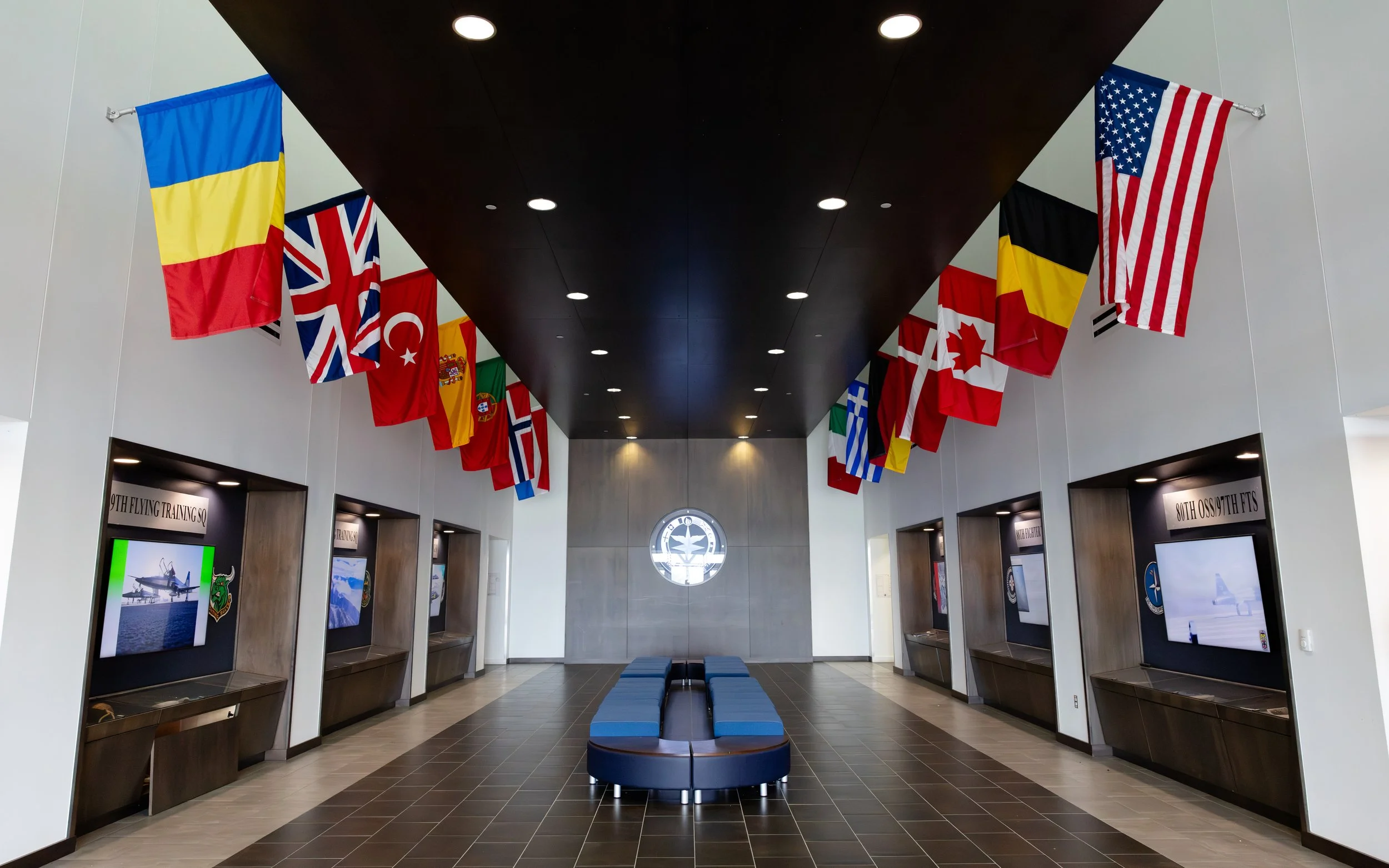
Walking through the headquarters building, the multinational character of ENJJPT becomes immediately apparent.
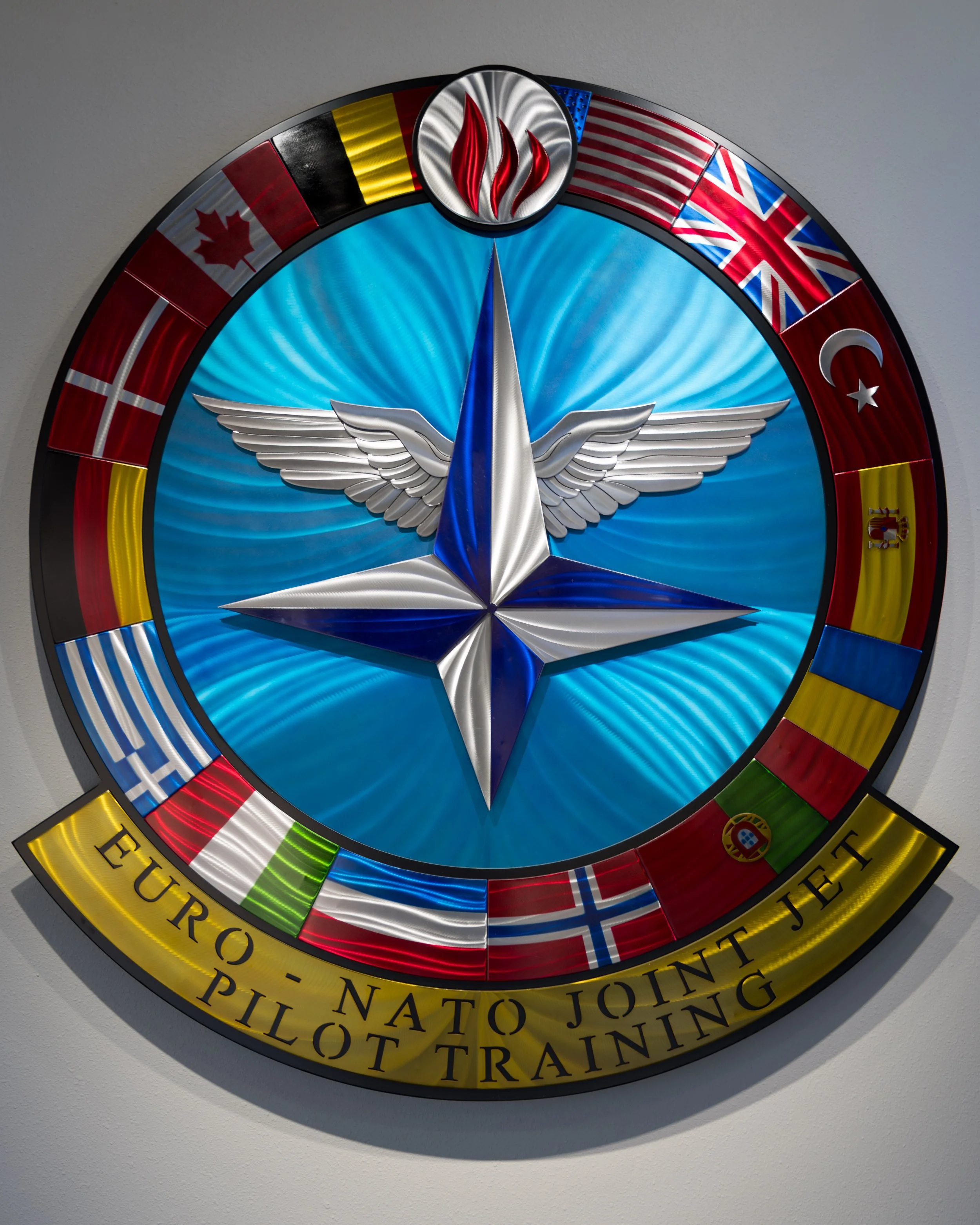
National flags line the corridors alongside photographs documenting more than four decades of training. Squadron emblems from participating nations share space with United States Air Force insignia, reflecting an organisation in which every partner contributes to a common mission rather than operating independently.
This integration extends well beyond symbolism.
Officers from participating nations serve throughout the command structure and instructional staff, allowing students to learn from a broad range of operational experience. During a single week, a student may attend an academic lesson delivered by one nation, fly with an instructor from another and receive a debrief from a third. English serves as the operational language, but the diversity of uniforms and squadron patches provides a constant reminder that ENJJPT belongs to the Alliance as a whole.
Despite those national differences, expectations remain identical.
Performance standards do not change according to nationality.
Neither does the syllabus.
Every student is assessed against the same criteria, reflecting the programme's commitment to producing pilots capable of operating confidently within multinational air operations.
Leading a Multinational Organisation
Overseeing an organisation of this scale requires balancing the requirements of fourteen partner nations while maintaining a single, consistent training standard. It is a responsibility that extends well beyond aircraft and flying schedules.
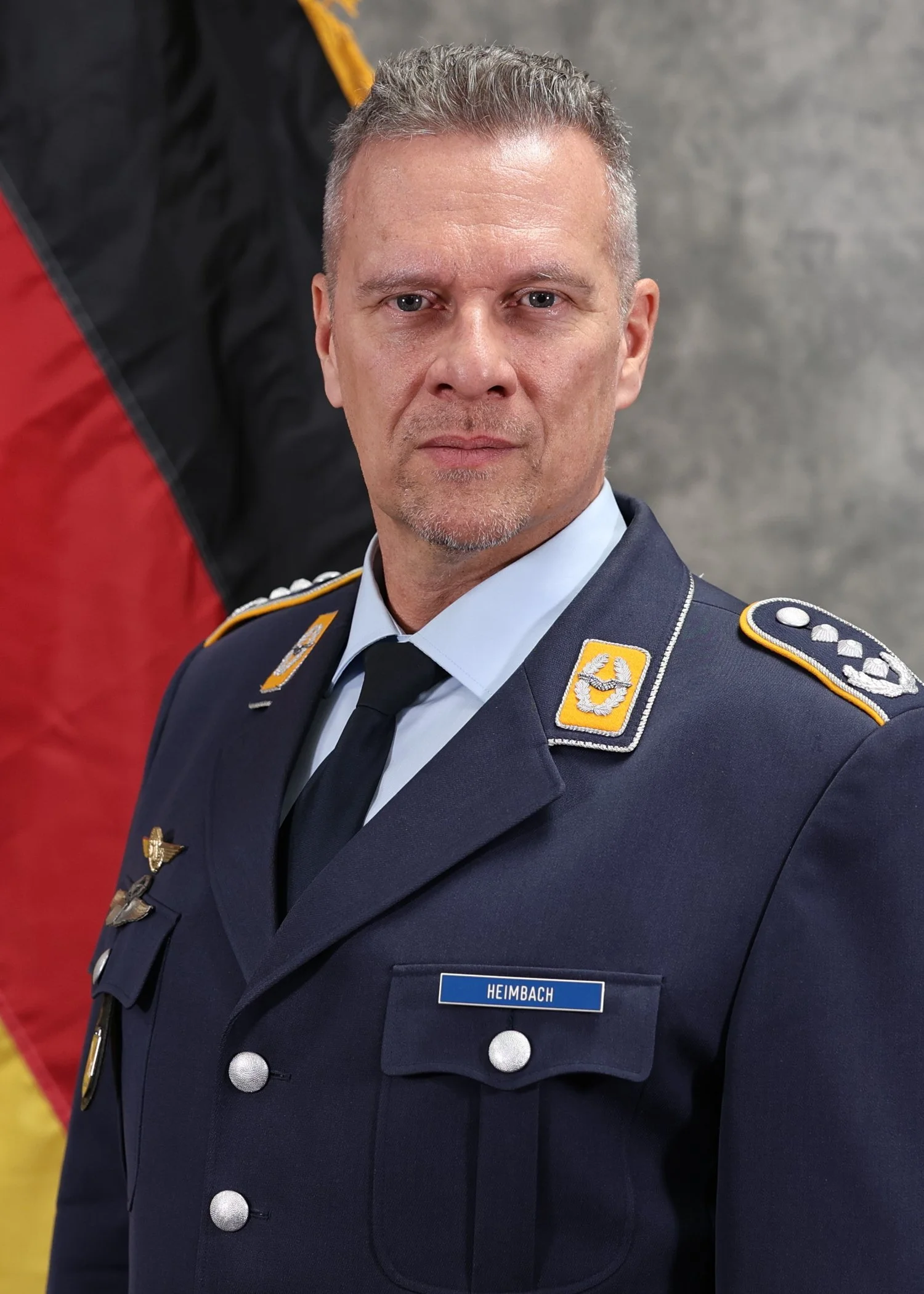
During our visit, Colonel Timo Heimbach, Operations Group Commander of the 80th Flying Training Wing, described ENJJPT as one of NATO's most enduring examples of practical cooperation. While the programme is recognised for producing fighter pilots, he explained that its broader value lies in developing officers who understand how to operate effectively within multinational coalitions from the very beginning of their careers. The professional relationships established during training often continue long after graduation, as former classmates meet again during exercises, deployments and operational assignments across the Alliance.
That perspective highlights an important distinction.
Modern coalition air operations depend upon far more than common equipment. They require shared procedures, mutual confidence and a professional culture built on standardisation and trust. Those qualities cannot be improvised during a deployment; they must be developed through a common training experience.
ENJJPT provides that experience.
Colonel Heimbach also emphasised that, although graduates eventually transition to a wide range of aircraft—including the Eurofighter Typhoon, Dassault Rafale, F-16 Fighting Falcon and F-35 Lightning II —the qualities expected of every military aviator remain remarkably consistent. Technical proficiency is essential, but so too are discipline, leadership, sound judgement and the ability to make effective decisions under pressure. These principles underpin every stage of the ENJJPT syllabus and remain equally relevant regardless of the aircraft students eventually fly.
Beyond Flying
Popular perception often associates military pilot training almost exclusively with flying. In reality, aircraft handling represents only one component of a much broader educational process.
Modern fighter pilots operate in an environment defined by information. Navigation, communications, aircraft systems, tactical planning, fuel management and mission objectives must all be managed simultaneously, often while flying at high speed in demanding conditions. Success therefore depends as much on decision-making and workload management as it does on flying ability.
ENJJPT reflects that reality.
Throughout the syllabus, instructors deliberately increase workload in carefully structured stages. Students first develop confidence in fundamental aircraft handling before progressively introducing navigation, instrument flying, formation procedures, emergency management and tactical decision-making. The objective is not simply to teach individual skills, but to develop the mental capacity required to manage several tasks simultaneously without compromising safety or performance.
As Colonel Heimbach observed, future operational environments will become increasingly complex as fifth-generation aircraft, advanced sensor integration and networked operations continue to evolve. Preparing pilots for that environment begins long before they reach an operational conversion unit. It starts by developing disciplined officers capable of analysing information, adapting to changing situations and making sound decisions under pressure.
Those qualities begin to take shape well before students ever start an aircraft engine.
For every future fighter pilot arriving at Sheppard Air Force Base, the first challenge is not learning to fly—it is earning the opportunity to do so.
Selecting Tomorrow's Fighter Pilots
Before a student ever arrives at Sheppard Air Force Base, the most competitive phase of the journey has already taken place.
ENJJPT does not recruit civilian applicants directly. Instead, each participating nation selects its own officer candidates before assigning them to the programme. Although selection procedures differ between air forces, every student has already demonstrated the academic ability, physical fitness and leadership potential required to begin military flying training.
Competition is intense.
For many NATO nations, the number of aspiring military pilots far exceeds the available training positions. Selection therefore extends well beyond flying aptitude. Candidates undergo comprehensive medical examinations, psychological assessments and academic evaluations designed to determine not only whether they can fly, but whether they possess the qualities required to operate safely in demanding military environments.
Leadership is equally important.
Future fighter pilots must communicate effectively, make decisions under pressure and function within highly disciplined teams. Flying ability alone is insufficient. Modern air operations demand officers capable of assuming responsibility both inside and outside the cockpit.
By the time students report to ENJJPT, they have already overcome one of the greatest hurdles of their careers.
The challenge that follows is transforming that potential into operational competence.
Preparing to Fly
One of the first surprises for those unfamiliar with military flying training is how little time students initially spend in the aircraft.
Before the first engine start, weeks are devoted to academic instruction covering aerodynamics, aircraft systems, meteorology, navigation, regulations and emergency procedures. Students are expected to understand not only how to operate the aircraft, but also why it behaves as it does under different conditions.
This emphasis on theory reflects the demands of modern military aviation.
Aircraft systems have become increasingly sophisticated, while operational environments require pilots to process large amounts of information quickly and accurately. A thorough understanding of the aircraft therefore becomes essential long before students begin applying that knowledge in the cockpit.
Learning extends well beyond scheduled classroom lessons.
Mission preparation, procedural study and self-directed revision quickly become part of the daily routine. Every simulator event and every sortie is preceded by extensive preparation, ensuring that valuable flying time is used to reinforce knowledge rather than introduce entirely new concepts.
The pace is demanding, but intentionally so.
Military aviation rewards preparation. Students who arrive thoroughly briefed are able to devote their attention to aircraft handling and decision-making rather than searching for checklists or recalling procedures from memory.
Chair Flying
Among the most valuable techniques introduced during this phase is chair flying, a training method used extensively throughout military aviation.
Using cockpit diagrams or mock-up panels, students mentally rehearse an entire sortie from engine start to shutdown, verbally following checklists, radio calls and aircraft procedures exactly as they would perform them in flight.
Although deceptively simple, the technique serves an important purpose.
Repetition builds familiarity.
Familiarity reduces workload.
Reduced workload allows pilots to devote more attention to situational awareness and decision-making once airborne.
Chair flying therefore transforms many cockpit actions from conscious tasks into instinctive routines before the student ever straps into the aircraft.
It is a technique that remains common not only in training squadrons, but throughout operational fighter units across NATO.
Preparing for the Unexpected
Military flying assumes that emergencies are rare—but never impossible.
For that reason, students spend considerable time learning the systems designed to protect them should something go wrong.
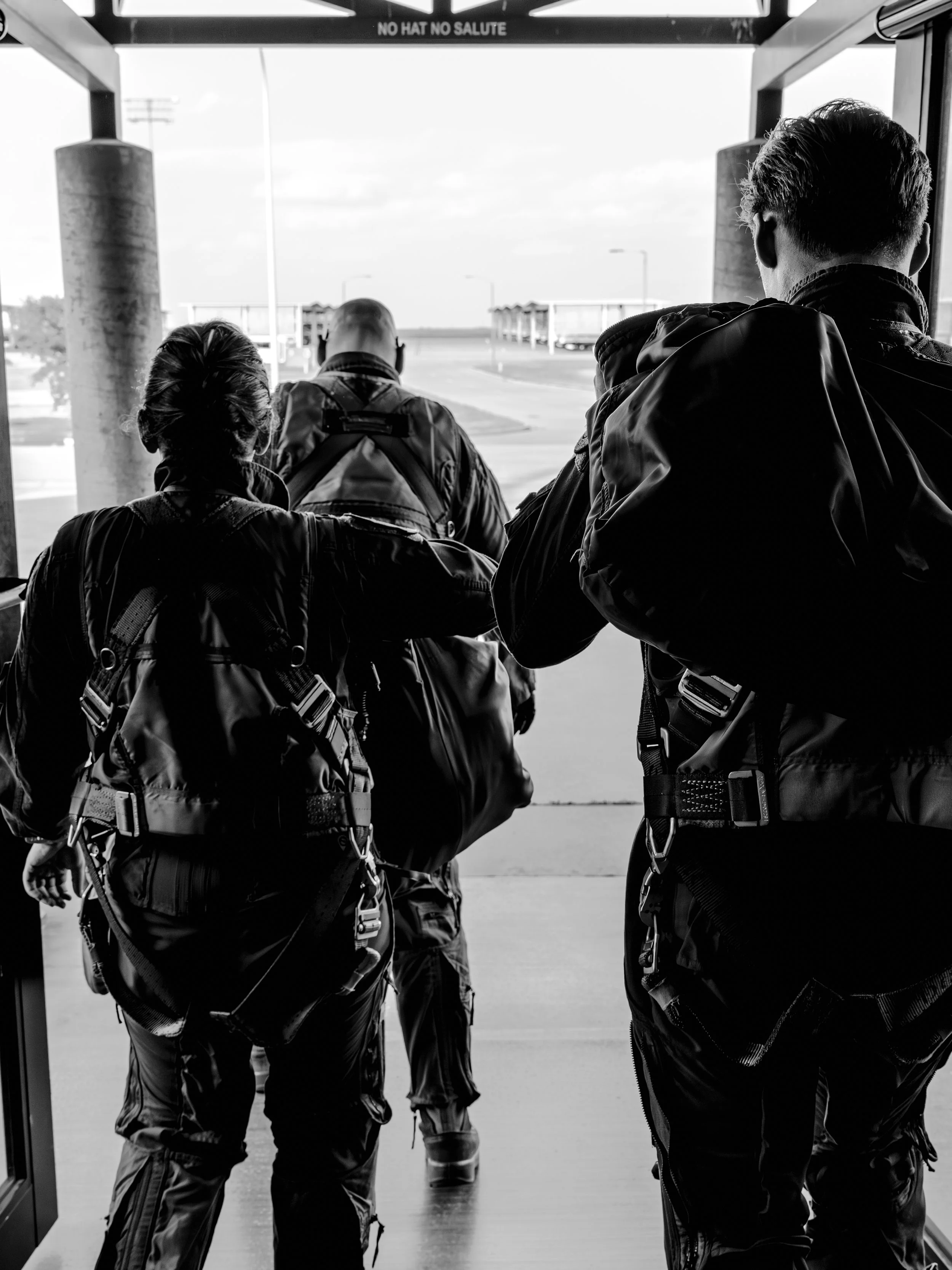
During our visit, the Egress and Life Support section demonstrated how survival equipment forms an integral part of military flight training. Students are introduced to parachute assemblies, restraint systems, oxygen equipment, helmets and emergency procedures long before they begin flying. Each component is examined not simply from the perspective of operation, but also in terms of the reasoning behind its design and employment.
The objective is straightforward.
When faced with an emergency, there is no time to study equipment or debate procedures.
Correct actions must already be instinctive.
Like every other aspect of ENJJPT, these lessons are built progressively, ensuring that students understand both the equipment itself and the principles governing its use.
The emphasis on preparation reflects a broader philosophy encountered throughout the programme.
Professional standards are established before they are required.
From Theory to Practice
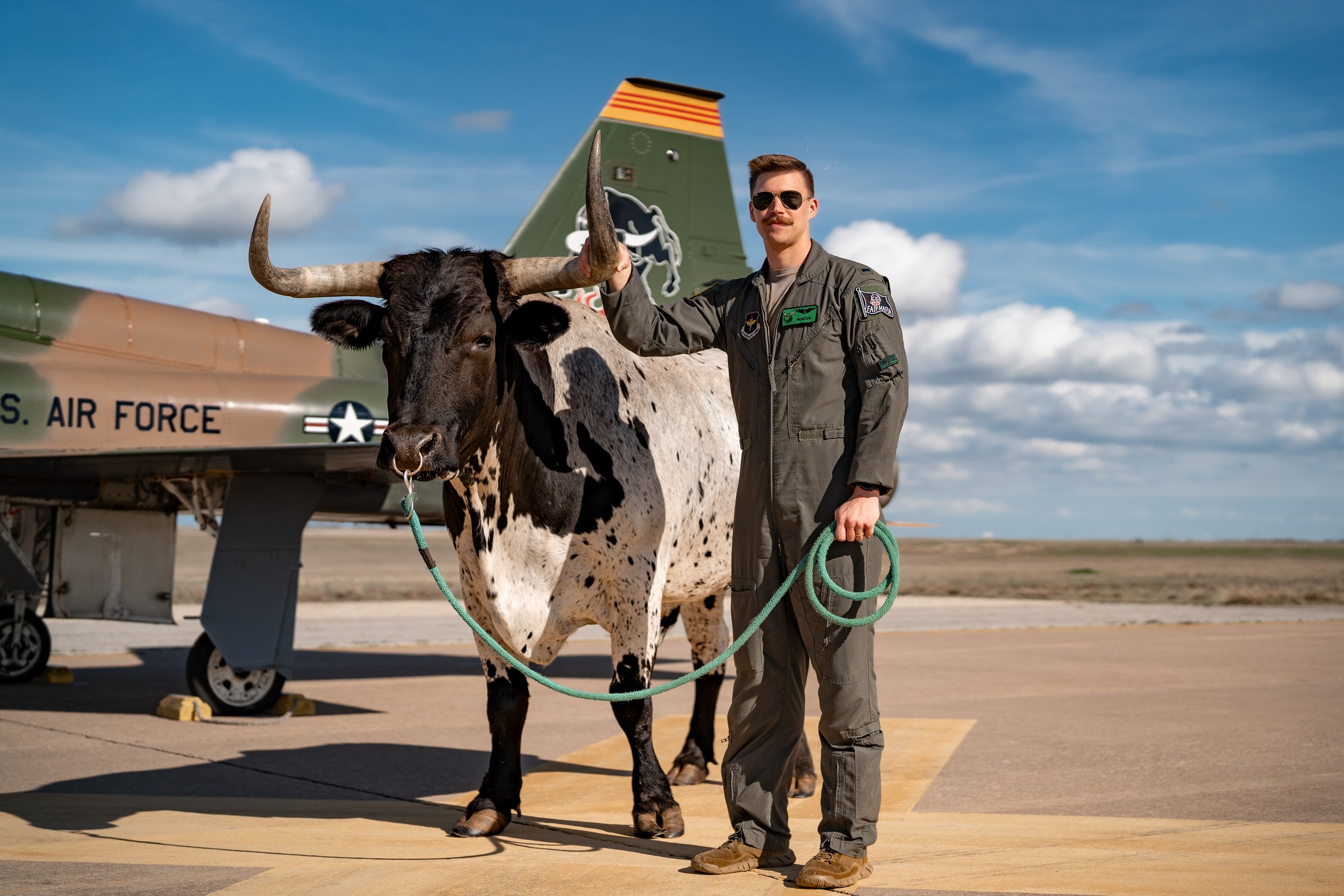
Once students have mastered the academic foundations of military aviation, attention shifts towards applying that knowledge in a controlled environment.
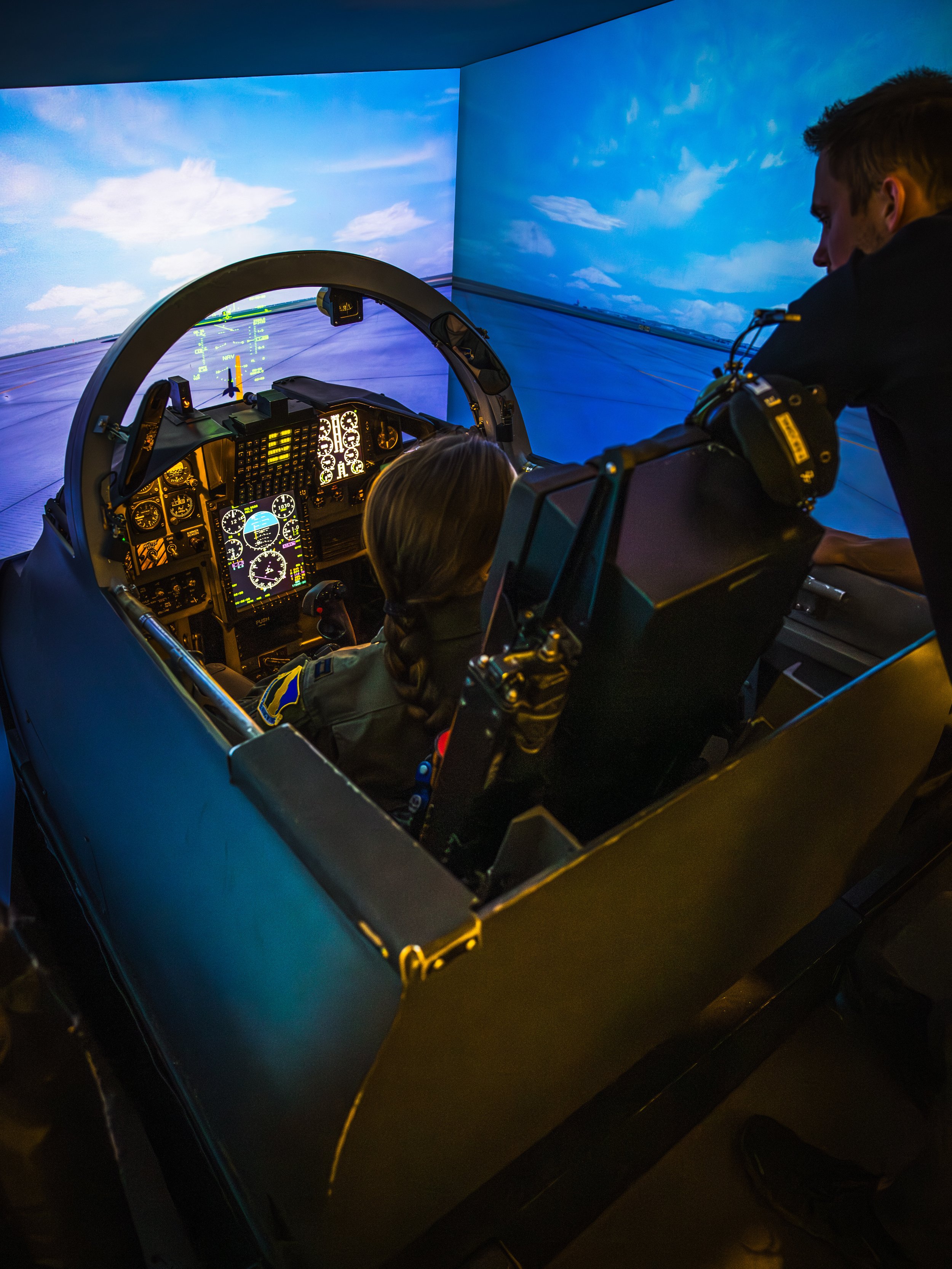
Before flying a real aircraft, every student enters the simulator.
Here, instructors can recreate normal procedures, poor weather, equipment malfunctions and emergency situations without the operational constraints or risks associated with airborne training. Students are encouraged to make decisions, experience the consequences and repeat exercises until the correct responses become second nature.
The simulator therefore represents far more than an economical substitute for flying.
It is where theoretical knowledge begins its transition into practical judgement.
That philosophy was perhaps best summarised by Instructor Pilot 1st Lt. Bobby Mitchell, who described military flying training as a process of building confidence through repetition rather than expecting perfection from the outset.
His classroom would provide the clearest demonstration of that approach.
Inside the Simulator Building Where Knowledge Becomes Instinct
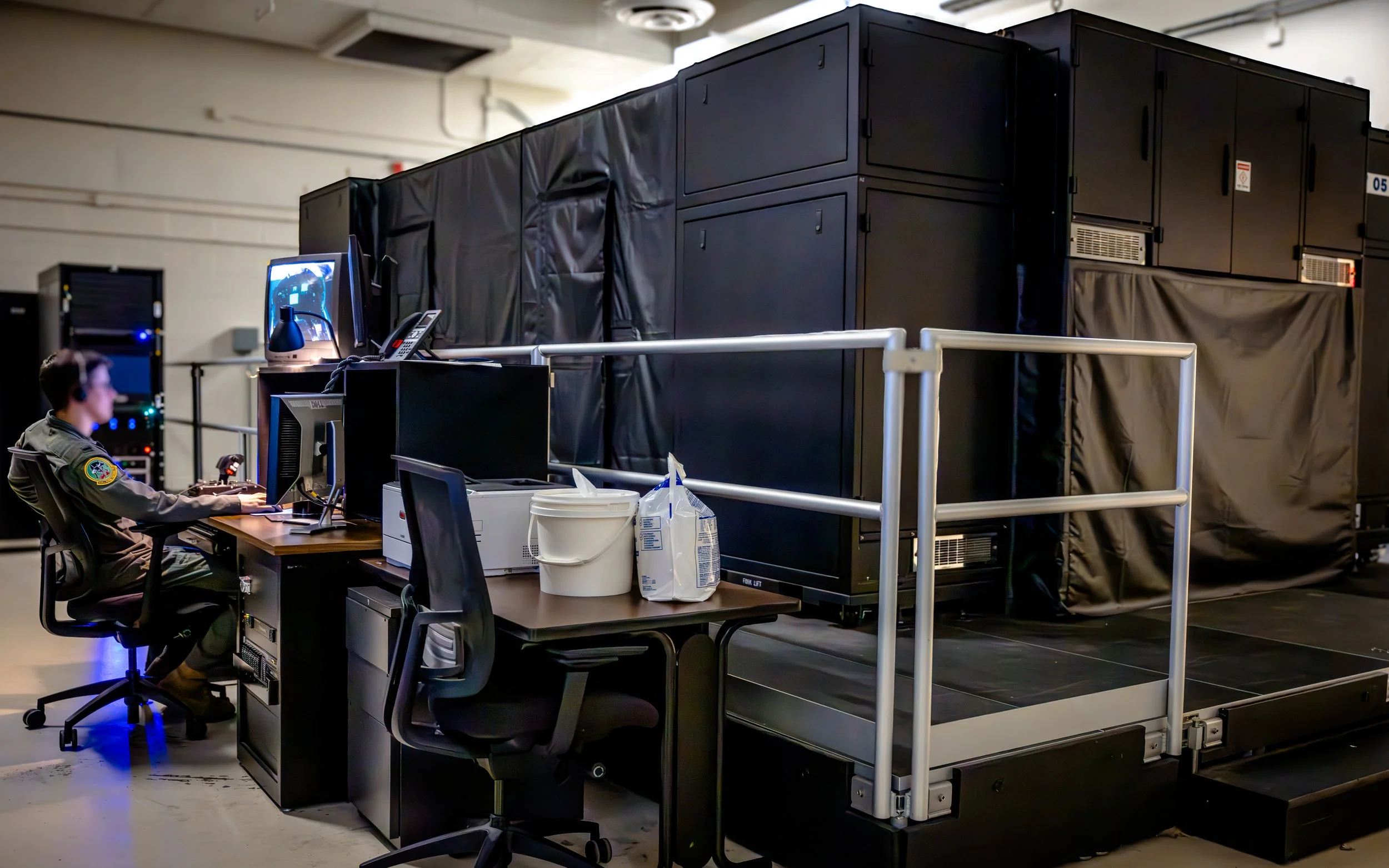
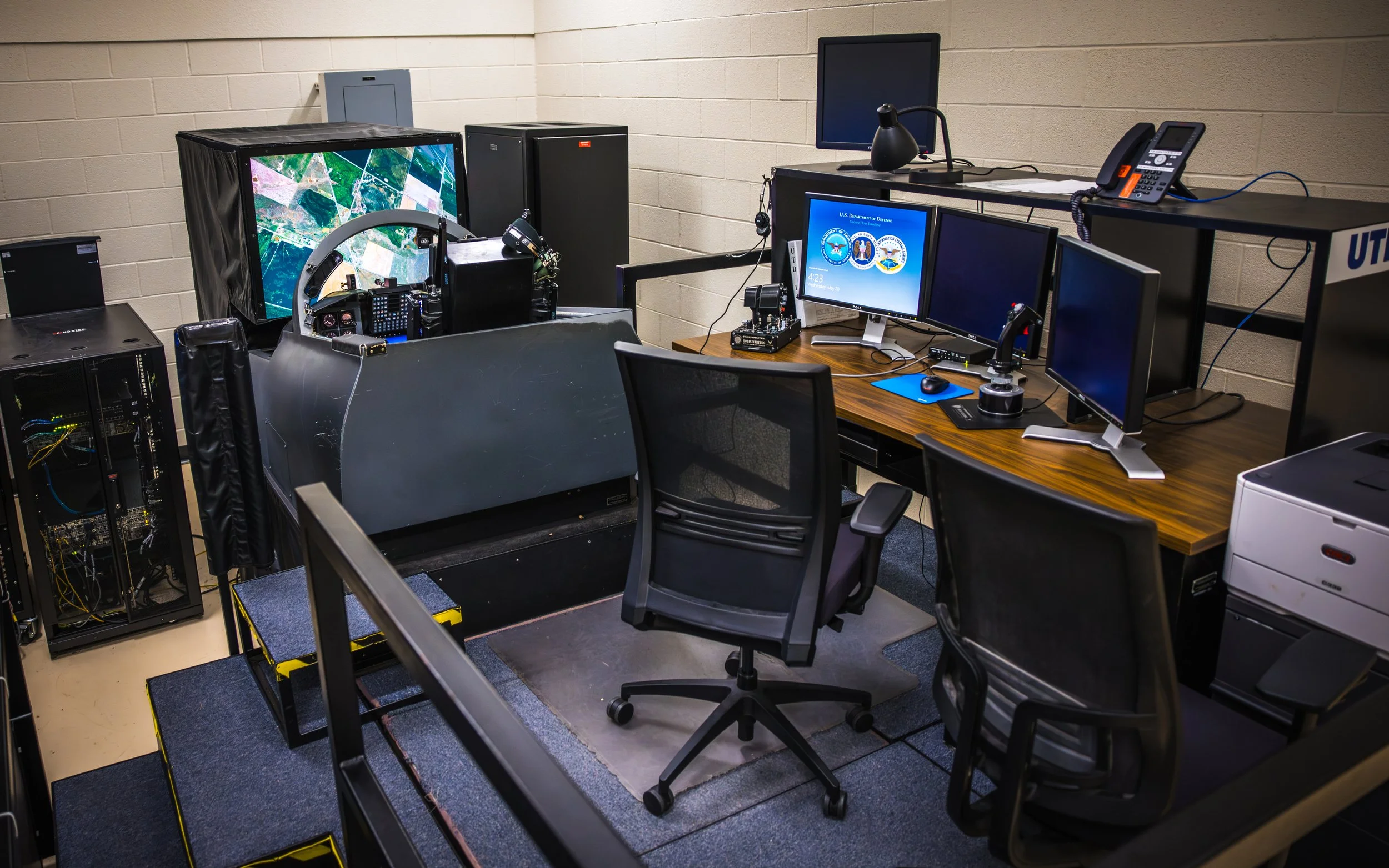
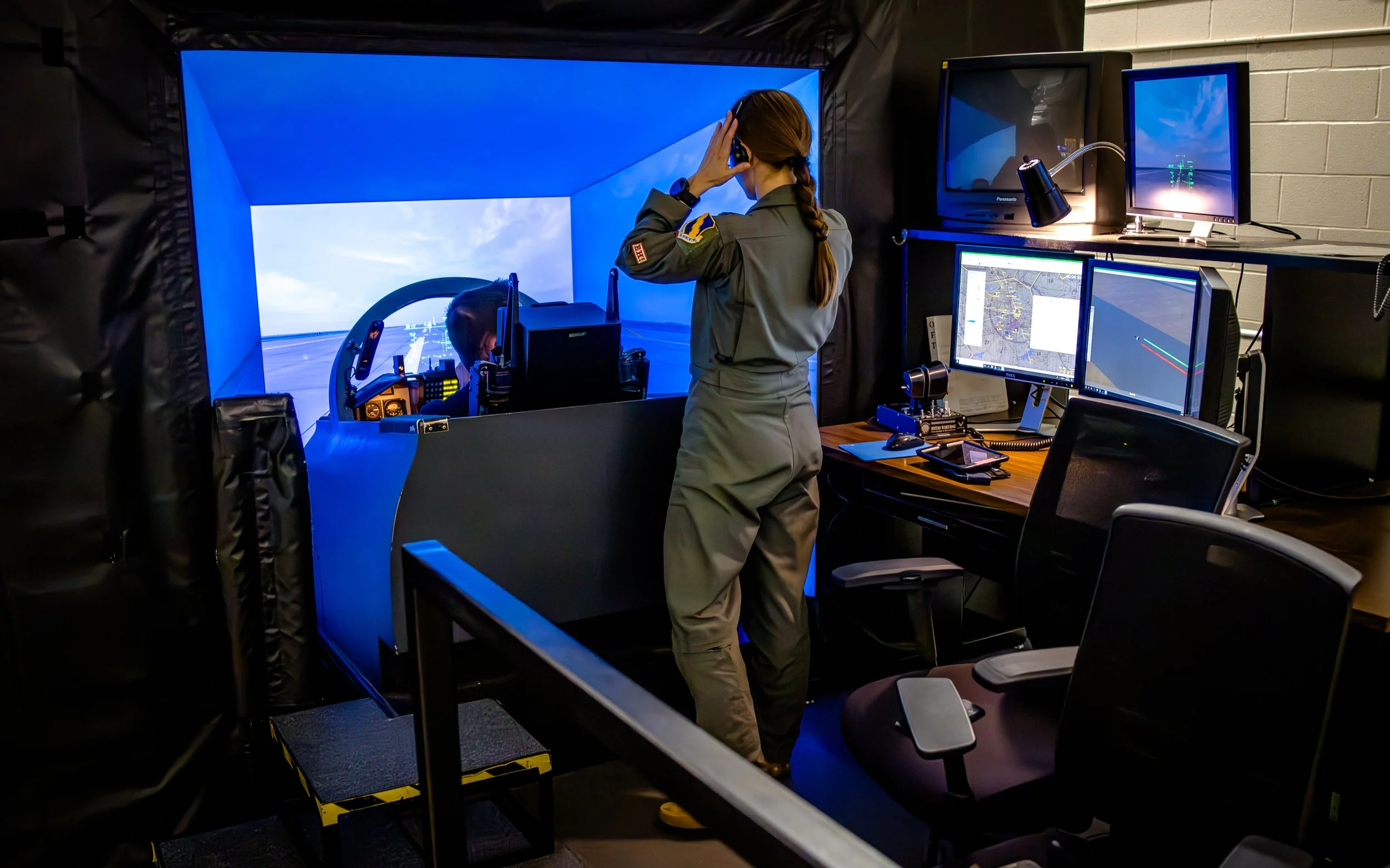
Long before students take control of a T-6 Texan II, they spend countless hours inside the simulator building. Here, procedures are refined, mistakes are analysed and confidence is developed in an environment where instructors can recreate situations that would be impractical—or unsafe—to introduce during flight.
Modern military simulators are far more than procedural trainers.
They allow instructors to expose students to abnormal situations, deteriorating weather, aircraft system failures and increasing levels of workload while maintaining complete control over the training environment. Every scenario can be paused, repeated and discussed in detail, allowing students to understand not only what happened, but why.
The result is a learning environment where errors become valuable teaching opportunities rather than safety concerns.
For ENJJPT, the simulator is not a substitute for flying.
It is where students begin thinking like military pilots.
Building Confidence Through Repetition
Instructor Pilot 1st Lt. Bobby Mitchell explained that one of the most common misconceptions about military flight training is that successful students are simply those with the greatest natural flying ability.
In reality, preparation consistently outweighs raw talent.
Students who arrive thoroughly prepared, understand the mission objectives and are willing to learn from constructive criticism generally progress more consistently than those relying solely on instinct. Military flying, he explained, is a profession built upon discipline, repetition and continuous improvement rather than individual brilliance.
That philosophy is reflected throughout every simulator event.
Rather than immediately correcting mistakes, instructors frequently encourage students to analyse the situation themselves. By asking questions, discussing decision-making and reviewing the sequence of events, instructors help students understand not only what occurred but also the reasoning behind the correct response.
The objective is not simply to produce pilots capable of following procedures.
It is to develop officers capable of understanding them.
"Crawl, Walk, Run"
Throughout our discussions, one expression surfaced repeatedly.
"Crawl, walk, run."
For Mitchell, these three words summarise the instructional philosophy that underpins the entire ENJJPT syllabus.
Students are never expected to master every aspect of military aviation immediately. Instead, new skills are introduced progressively, allowing confidence to develop before workload is increased.
Aircraft handling comes first.
Once maintaining altitude, heading and airspeed becomes routine, navigation is added.
Radio communications follow.
Formation procedures.
Instrument flying.
Emergency management.
Each new task builds directly upon those already mastered.
The objective is not simply to teach more skills.
It is to ensure that existing ones require progressively less conscious effort.
Only then can students begin managing the complexity expected of modern fighter pilots.
As Mitchell explained, instructors are continually assessing more than whether a manoeuvre is completed correctly. They are equally interested in how much mental capacity remains once that task has been completed. A student operating at the limits of their workload may successfully fly the aircraft under normal conditions, but unexpected events quickly expose the lack of spare cognitive capacity. Developing that reserve is one of the programme's principal objectives.
Learning to Think Ahead of the Aircraft
One theme emerged repeatedly throughout the interview.
Military aviation is fundamentally about managing workload.
Flying the aircraft is only one element of the task. Pilots must simultaneously monitor aircraft systems, communicate with other aircraft and air traffic control, navigate accurately, anticipate changing conditions and remain prepared to respond immediately if circumstances change.
The simulator provides the ideal environment in which to develop these habits.
As students become increasingly comfortable with basic procedures, instructors deliberately introduce additional challenges. A weather deterioration may require an instrument approach. An aircraft malfunction may interrupt an otherwise routine sortie. Radio congestion or changing mission requirements may force students to reprioritise tasks while continuing to fly accurately.
These scenarios are not intended to catch students out.
They are designed to teach adaptability.
By repeatedly exposing students to manageable increases in workload, ENJJPT develops pilots capable of maintaining situational awareness even when conditions become significantly more demanding than planned.
The Importance of the Debrief
If the simulator is where mistakes occur safely, the debrief is where the real learning takes place.
Every session concludes with a structured review during which instructor and student reconstruct the sortie in detail. Rather than focusing solely on errors, discussions centre on decision-making, workload management and the reasoning behind each action.
Mitchell described the debrief as one of the most valuable components of military flying training because it develops honest self-assessment. Operational fighter pilots will spend much of their careers making decisions independently. The ability to evaluate one's own performance objectively, identify weaknesses and continuously improve is therefore every bit as important as technical flying skill.
Students are encouraged to critique their own performance before receiving instructor feedback. This approach promotes accountability while reinforcing a culture in which continuous improvement is viewed not as a sign of weakness, but as an essential characteristic of professional military aviation.
More Than a Simulator
Watching students rotate through successive simulator events, one impression became increasingly clear.
Confidence at ENJJPT is not built by avoiding mistakes.
It is built by understanding them.
Every briefing, simulator session and debrief contributes to the same objective: reducing the mental effort required for routine tasks so that attention can be directed towards decision-making, situational awareness and leadership.
It is a philosophy that extends well beyond the simulator building.
The same structured preparation, disciplined execution and continuous self-assessment can be seen on the flight line, in the control tower and ultimately in the cockpit itself.
The next stage of the syllabus would demonstrate how those lessons are applied once the aircraft leaves the ground.
Life on the Flight Line Where the Programme Comes Together
After spending time in classrooms and simulators, the flight line reveals how every element of ENJJPT is brought together in daily operations.
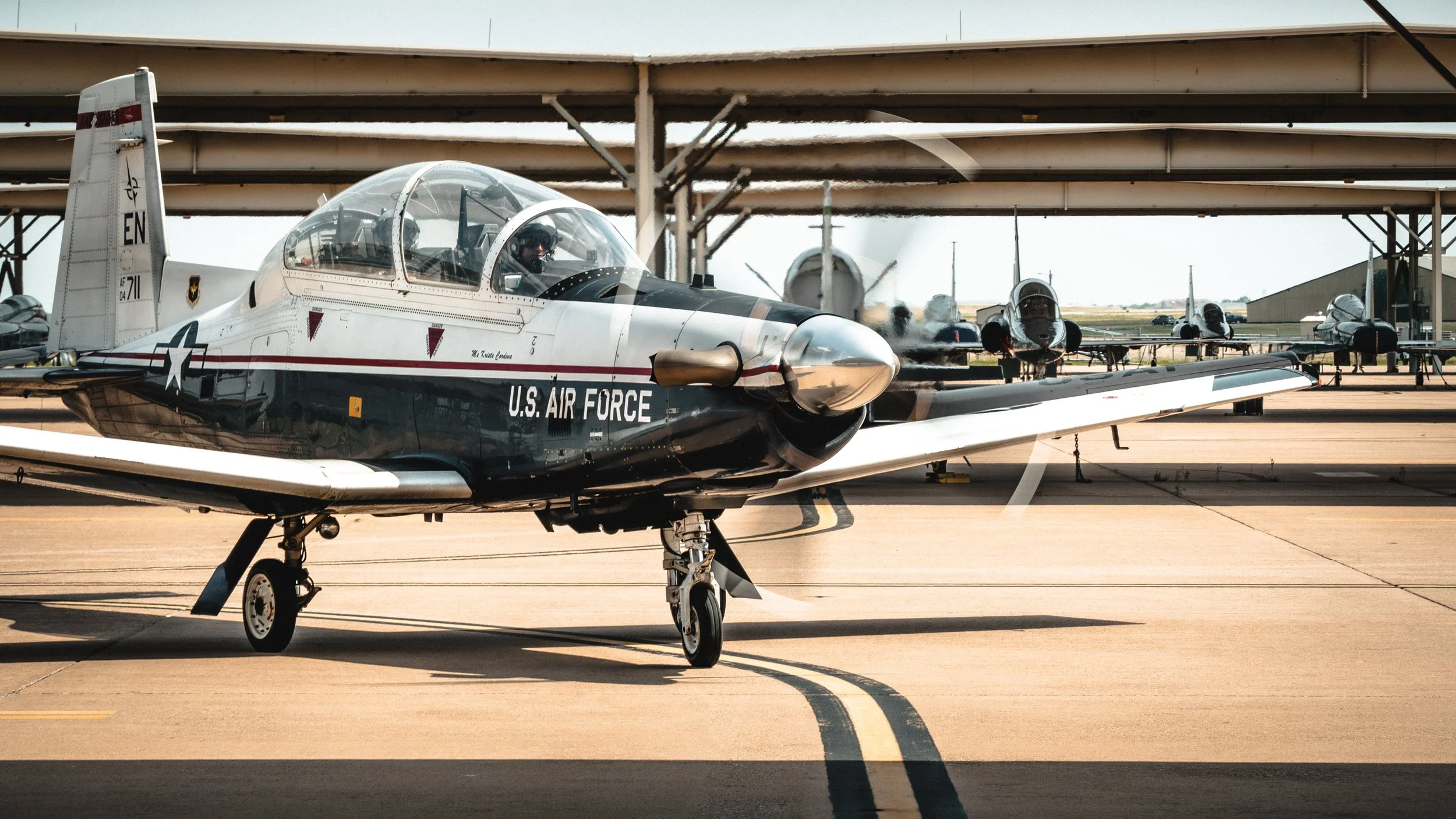
From first light, Sheppard Air Force Base settles into a carefully coordinated rhythm. Students arrive for mission briefings, instructors review training objectives, maintenance teams complete final inspections and operations personnel monitor the day's flying schedule. Within a relatively short period, aircraft begin taxiing in succession towards the runway while another wave prepares for the following launch.
Although the pace is demanding, very little appears rushed.
Every activity follows an established sequence designed to maximise efficiency while maintaining the high safety standards expected throughout military aviation.
It is an environment where preparation is just as important as execution.
A Coordinated Effort
Every sortie generated by ENJJPT depends upon the work of numerous specialists whose contribution often goes unnoticed outside the organisation.
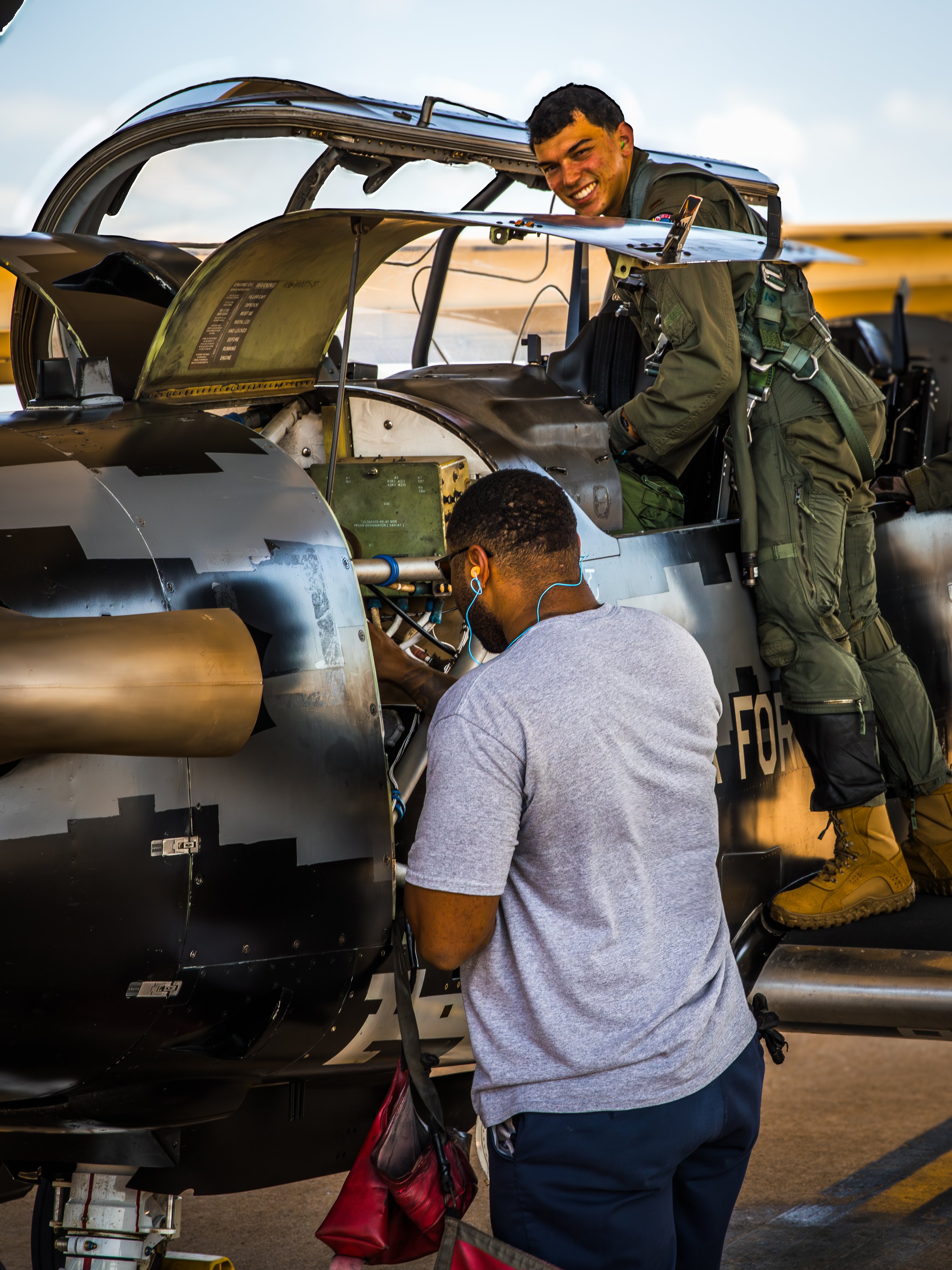
Long before a student straps into the cockpit, aircraft have been inspected, fuelled and prepared for flight. Operations personnel have coordinated instructor assignments, flying schedules and airspace requirements. Life-support specialists have inspected helmets, parachutes and survival equipment, while meteorologists have analysed the day's weather to support mission planning.
Each individual task is relatively straightforward.
Collectively, they create the conditions that allow hundreds of training sorties to be conducted safely throughout the year.
This coordination becomes particularly important within a programme where students are progressing continuously through different phases of the syllabus. Aircraft availability, instructor continuity and simulator schedules must remain closely aligned to avoid disrupting training progression.
Maintaining that balance is one of the less visible achievements of the 80th Flying Training Wing.
Preparing the Aircraft
Before every flight, instructors and students conduct a systematic external inspection of the aircraft.
Although maintenance personnel have already certified the aircraft for flight, pilots remain responsible for confirming its condition before accepting it. Beginning at the nose, the inspection follows a fixed sequence covering the propeller, engine intakes, landing gear, control surfaces, fuel system and external panels before concluding at the cockpit.
The process rarely changes.
Its consistency is intentional.
Military aviation relies heavily on standardised procedures because routine is one of the most effective ways of reducing human error. Regardless of experience level, pilots perform the inspection in exactly the same order, ensuring that no item is overlooked simply because attention has shifted elsewhere.
For students, these habits are established from the very beginning of the syllabus and remain with them throughout their operational careers.
The Briefing
Every training sortie begins in the briefing room.
Here, instructor and student review the objectives of the mission, expected weather conditions, planned routing, emergency procedures and individual learning goals. Questions are encouraged, and students are expected to explain procedures rather than simply acknowledge them.
Throughout our visit, one aspect of these briefings stood out.
Instructors consistently asked why.
Why would a particular procedure be appropriate?
Why select one recovery option instead of another?
Why prioritise one task over the next?
The emphasis was rarely on memorising a checklist.
It was on understanding the reasoning behind it.
This approach reflects the broader instructional philosophy observed throughout ENJJPT. Students are encouraged to think critically, understand the aircraft and develop sound judgement rather than relying exclusively on memory.
Building Professional Habits
Watching successive crews prepare for departure quickly demonstrated that military flying is built upon routine.
Equipment checks are performed methodically.
Mission materials are organised consistently.
Harnesses are verified.
Radio frequencies confirmed.
Checklists followed without shortcuts.
Individually, these actions appear unremarkable.
Together, they establish the disciplined habits that allow pilots to operate effectively when workload inevitably increases.
As students progress through the syllabus, these routines gradually become instinctive, allowing greater attention to be directed towards aircraft handling, tactical decision-making and situational awareness.
The objective is not simply to complete procedures correctly.
It is to make them second nature.
The Rhythm of Operations
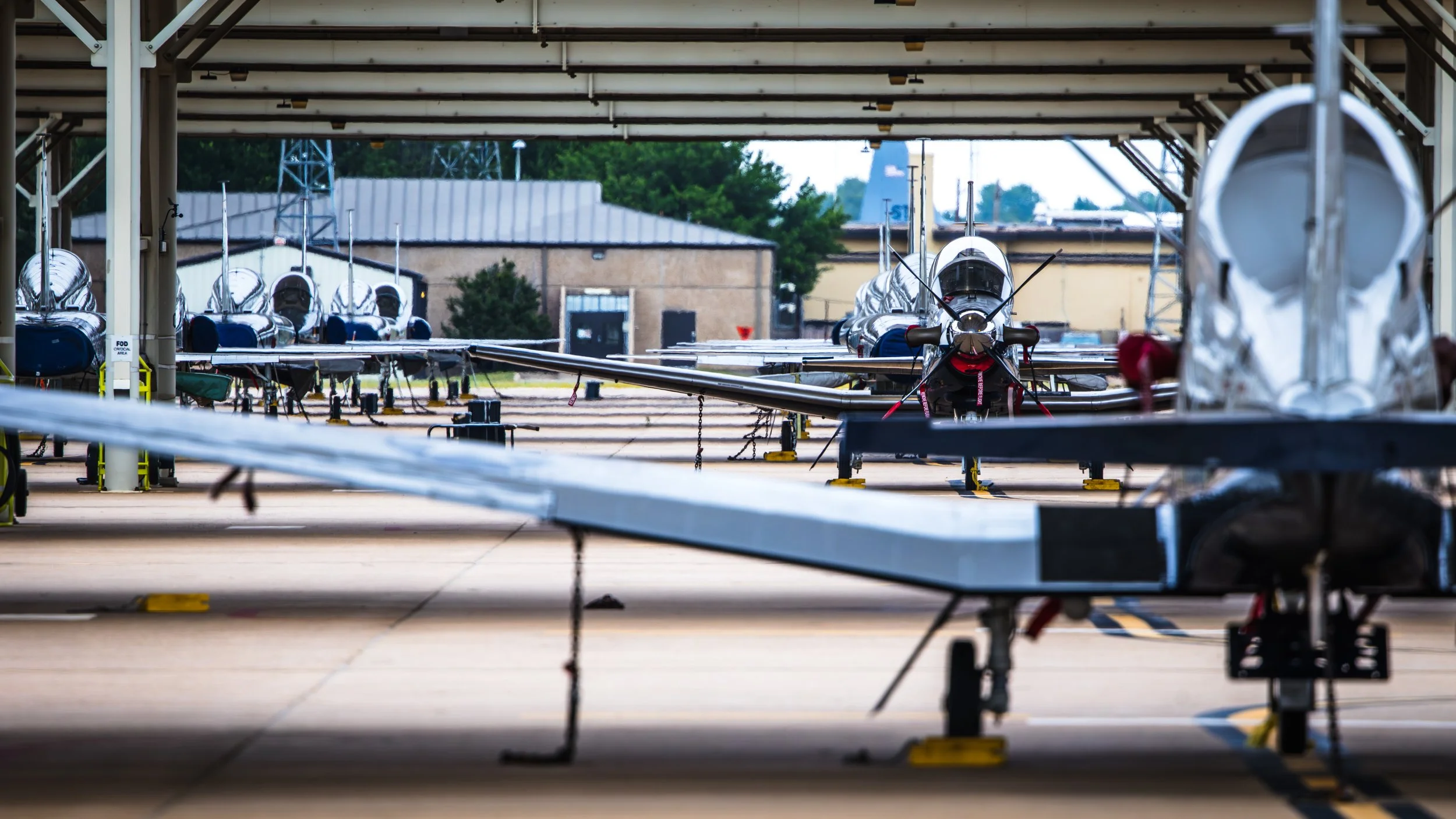
As the day progresses, aircraft recover while others taxi for departure, creating a continuous flow of activity across the ramp.
Maintenance personnel begin post-flight inspections almost as soon as engines shut down. Students proceed directly to debriefs while instructors prepare for their next sortie. Operations personnel update the flying schedule, ensuring that aircraft, instructors and simulator events remain synchronised throughout the day.
The flight itself represents only one stage of a much larger process.
Preparation before the sortie and analysis afterwards often require considerably more time than the period spent airborne.
That cycle—brief, prepare, fly, debrief and study—is repeated day after day throughout the syllabus. It is demanding, but it mirrors the operational tempo graduates will encounter later in frontline squadrons.
Standing on the flight line, it becomes clear that ENJJPT is not simply teaching students how to fly an aircraft.
It is introducing them to the professional culture of military aviation.
Beyond the Ramp
While the flight line provides the most visible expression of daily flying operations, another organisation works continuously behind the scenes to keep that activity moving safely and efficiently.
Inside the control tower, Air Traffic Controllers coordinate every departure, arrival and training profile, ensuring that one of the busiest military training airfields in the United States operates with the precision expected of a NATO fighter training programme.
Their role is rarely visible to visitors.
Its importance, however, is impossible to overstate.
Air Traffic Control Coordinating Every Sortie
From the flight line, the control tower appears almost detached from the activity below. Aircraft taxi, depart and recover in a continuous rhythm while instructors and students focus on their individual missions.
Inside the tower, however, every movement is being monitored, coordinated and anticipated.
For ENJJPT, Air Traffic Control is far more than a regulatory requirement. It is an integral part of the training system, enabling hundreds of sorties to be conducted safely while accommodating students at different stages of the syllabus, instructor pilots, transient military traffic and civilian aircraft operating within the surrounding airspace.
Maintaining that balance requires continuous coordination.
Supporting the Training Mission
During our discussions with members of the Air Traffic Control team, one point became immediately apparent.
Controllers are not simply managing aircraft.
They are supporting instruction.
Understanding the objectives of each sortie allows controllers to anticipate the requirements of both instructors and students. They know which aircraft are conducting instrument training, which formations require additional spacing and which students may need slightly more time as they progress through the early stages of the syllabus. That familiarity enables them to contribute directly to the efficiency of the training programme while maintaining the high safety standards expected of military aviation.
Communication plays a central role in that process.
Military radio phraseology is deliberately concise, reducing unnecessary workload during critical phases of flight while ensuring that instructions remain clear and unambiguous. Although students arrive with varying levels of experience, they quickly learn that effective communication is every bit as important as accurate aircraft handling.
A Common Language
One of ENJJPT's defining characteristics is that students and instructors from fourteen NATO nations train together using the same operational procedures.
Air Traffic Control reflects that philosophy.
Regardless of nationality, radio communications follow standardised phraseology and internationally recognised procedures. This consistency allows students to build confidence in an environment that closely resembles the multinational operations they will encounter later in their careers.
As Colonel Timo Heimbach explained during our interview, ENJJPT is designed not only to produce capable fighter pilots, but also officers who can integrate seamlessly into coalition air operations from the outset of their operational service. Shared procedures and common standards form an essential part of that objective.
Learning Through Experience
Controllers also observe the development of students from a unique perspective.
As experience grows, radio transmissions become more concise, workload is managed more effectively and confidence naturally increases. Those changes are often evident long before a student reaches the advanced stages of the syllabus.
The progression mirrors the instructional philosophy seen throughout ENJJPT.
Routine tasks become increasingly instinctive.
Mental capacity becomes available for higher-level decision-making.
The objective is not simply to communicate efficiently, but to ensure that communication never becomes a distraction from flying the aircraft or managing the mission.
Part of a Larger Team
Leaving the control tower reinforced one of the strongest impressions of the visit.
Although fighter pilots naturally occupy the most visible role within military aviation, every successful sortie depends upon a much larger team. Controllers, maintainers, operations personnel, instructors and support specialists all contribute directly to the development of future NATO aviators.
That teamwork lies at the heart of ENJJPT.
The programme succeeds not because of any single aircraft or individual, but because every organisation works towards the same objective: preparing students for the demands of operational military aviation.
For the students themselves, that journey remains both demanding and intensely rewarding.
Understanding what it feels like to progress through the syllabus requires hearing from someone experiencing it first-hand.
The Student Perspective Learning to Become a Fighter Pilot
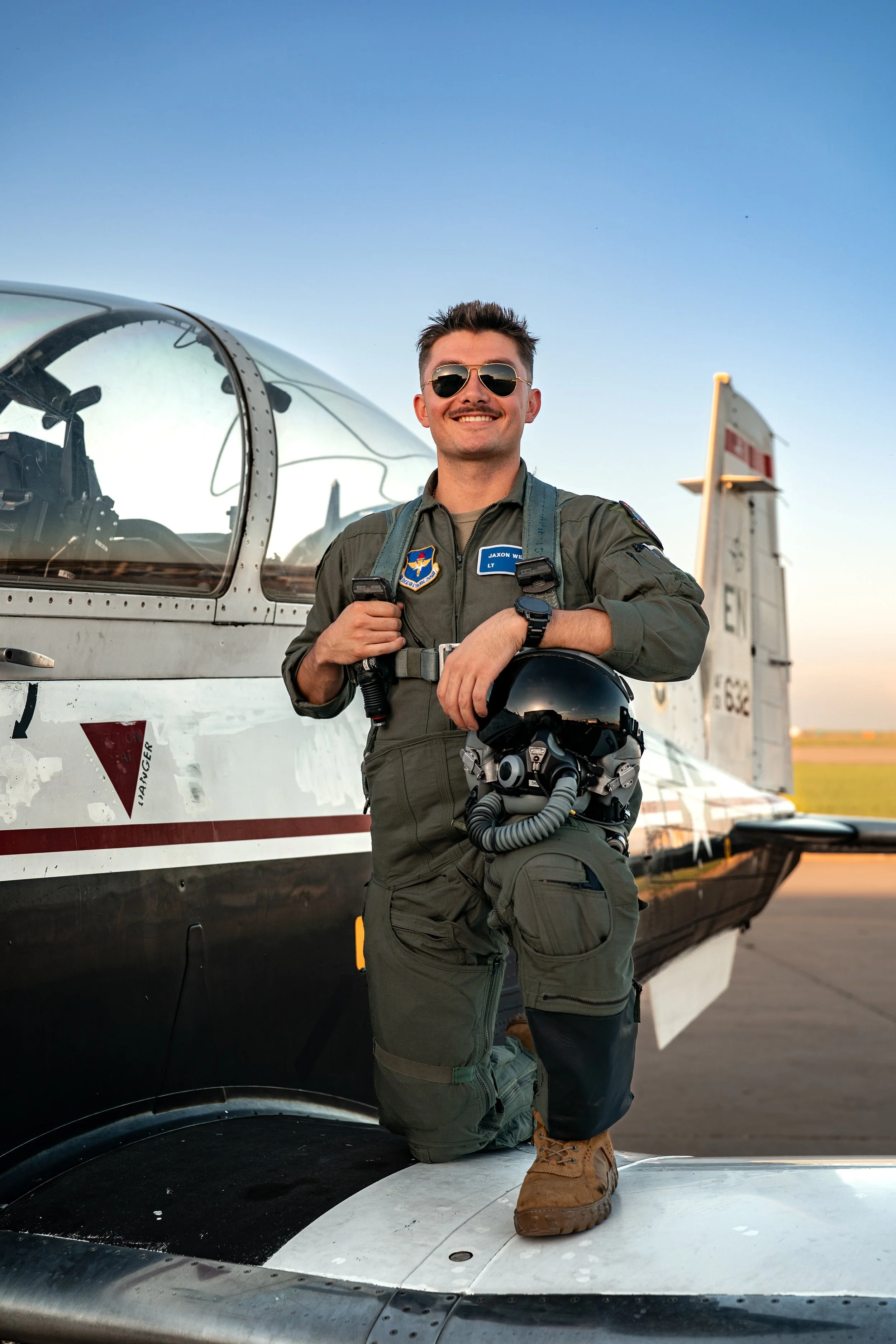
Every student arriving at ENJJPT begins the programme with the same objective: to earn the opportunity to fly frontline military aircraft.
What follows, however, is far more than a flying course. It is an intensive process of academic study, simulator instruction, flight training and continuous evaluation designed to prepare future officers for the demands of operational military aviation.
For Student Pilot 2nd Lt. Jaxon Willis, that journey began well before arriving in Texas.
After earning his commission through the United States Air Force Reserve Officer Training Corps (AFROTC), Willis was selected to attend ENJJPT—his preferred assignment because of its fighter-focused syllabus and multinational environment.
Like every student, he understood that selection represented the beginning of the challenge rather than its conclusion.
Living the Programme
Speaking with Willis, it quickly became apparent that daily life at ENJJPT revolves around preparation.
Flying occupies only a small portion of the working day. The majority of a student's time is spent studying aircraft systems, preparing missions, rehearsing procedures, attending simulator events and analysing previous sorties. Formal duties begin early each morning, but learning continues long after the flying schedule has ended.
That routine demands discipline as much as technical ability.
Willis explained that every flight requires extensive preparation beforehand and a detailed debrief afterwards, leaving little opportunity to rely on natural ability alone. Students quickly discover that consistency, organisation and effective time management are just as important as aircraft handling. Success is built through steady progress rather than dramatic breakthroughs.
The workload is demanding, but it reflects the realities of operational aviation, where preparation often occupies considerably more time than the mission itself.
Learning Together
One of the defining characteristics of ENJJPT is the opportunity to train alongside officers from across the NATO Alliance.
Before arriving at Sheppard Air Force Base, Willis expected the multinational environment to be one of the programme's most distinctive features. In practice, he found that national differences quickly became secondary to the common objective of meeting the same demanding training standards. English provides a common operational language, while standardised procedures ensure that instructors and students from different nations can work together seamlessly.
Throughout the course, students regularly fly with instructors from different countries and learn alongside classmates who will eventually return to operational squadrons across Europe and North America. Those professional relationships often continue well beyond graduation, creating connections that later support multinational exercises and coalition operations.
For Willis, this international environment represents one of ENJJPT's greatest strengths.
It provides an appreciation of allied air forces that would be difficult to replicate within a purely national training system.
Learning From Mistakes
Perhaps the most revealing aspect of our conversation concerned the programme's attitude towards mistakes.
According to Willis, instructors consistently encourage students to view errors as opportunities to improve rather than failures to avoid. Every sortie, whether successful or challenging, becomes another opportunity to identify weaknesses, refine procedures and build confidence before the next flight. Honest self-assessment is expected, and constructive criticism forms an integral part of the learning process.
This philosophy closely mirrors the approach described earlier by Instructor Pilot Bobby Mitchell.
Preparation.
Repetition.
Reflection.
Improvement.
Rather than expecting perfection from the outset, ENJJPT develops confidence through progressive instruction, allowing students to build experience while maintaining the demanding standards expected of future fighter pilots.
Looking Ahead
Like many student pilots, Willis has clear ambitions for the future.
His long-term goal is to fly the Lockheed Martin F-22 Raptor, but he is equally aware that every phase of training must be earned before looking towards an operational assignment. At the time of our visit, his immediate focus remained on completing the T-6 phase of the syllabus and preparing for one of the most significant milestones in any pilot's career: the first solo flight.
Reflecting on his experience at ENJJPT, Willis returned repeatedly to one central idea.
The programme is designed to challenge every student.
The expectations are high, the pace demanding and the standards uncompromising. Yet those same demands create an environment in which continuous learning becomes part of everyday life. Success is measured not by avoiding mistakes altogether, but by recognising them, understanding them and ensuring they are not repeated.
It is a mindset that extends far beyond military flying.
It is the foundation upon which professional military aviators are built.
The T-6 Texan II Putting Training Into Practice
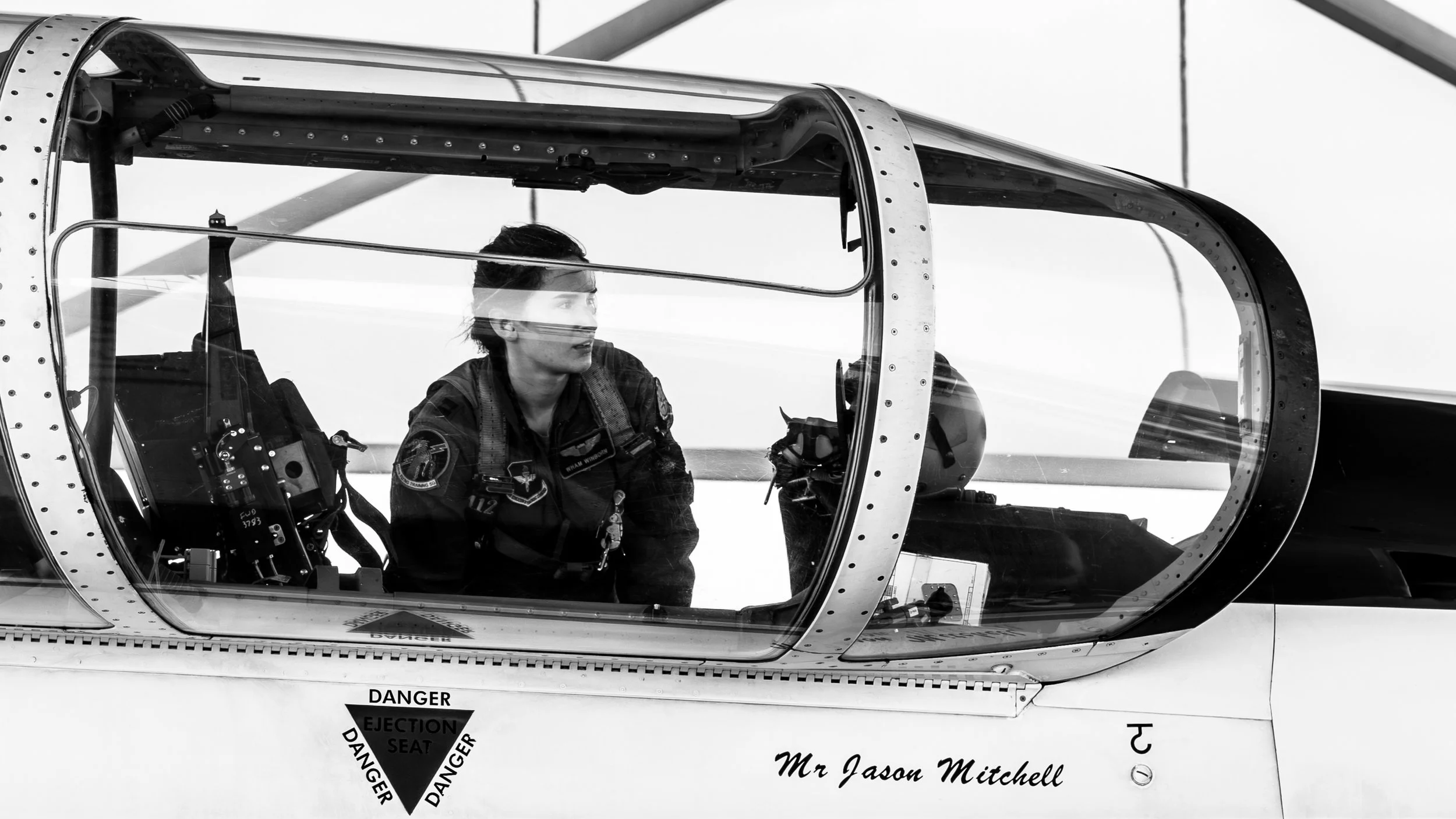
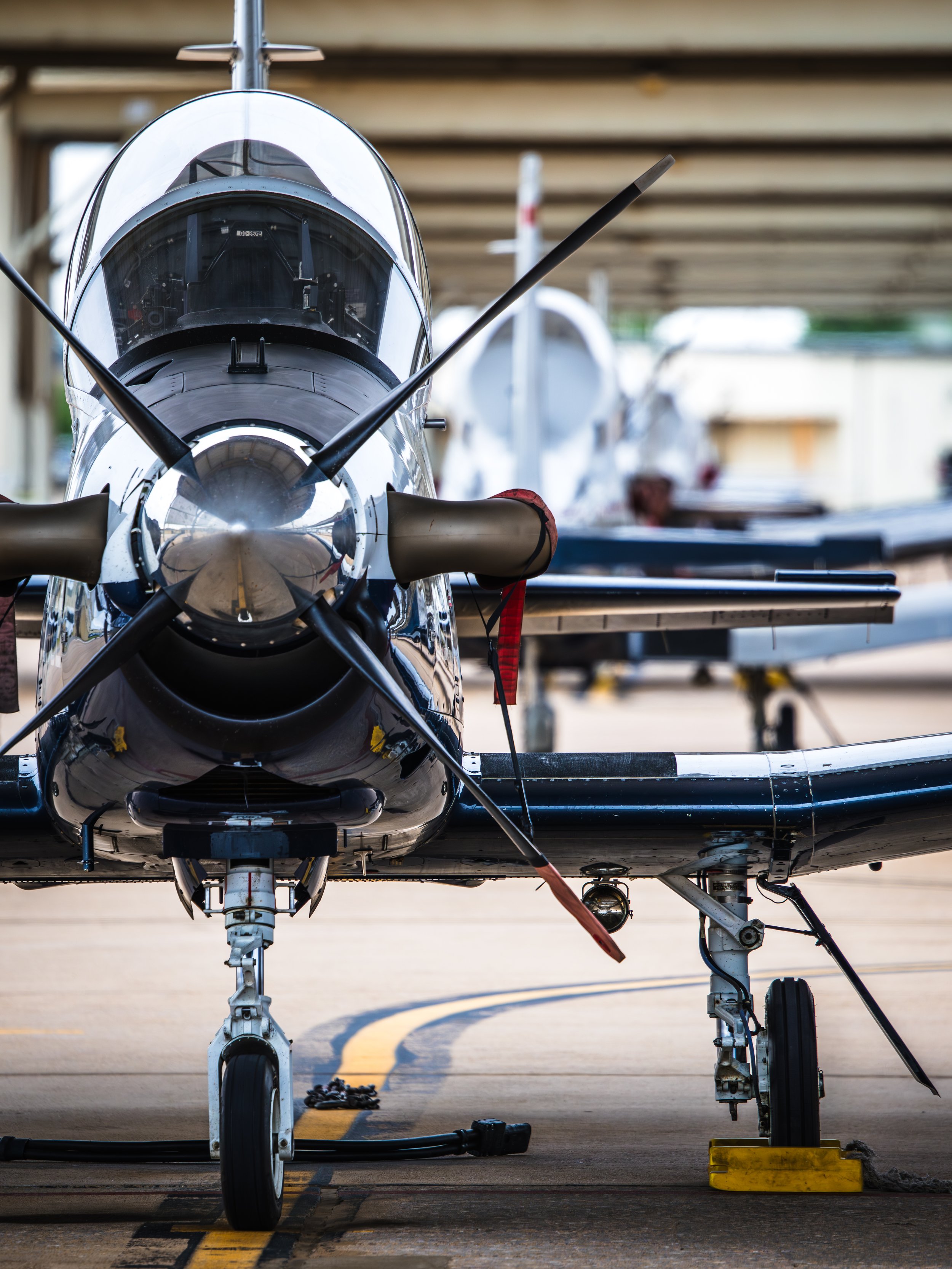
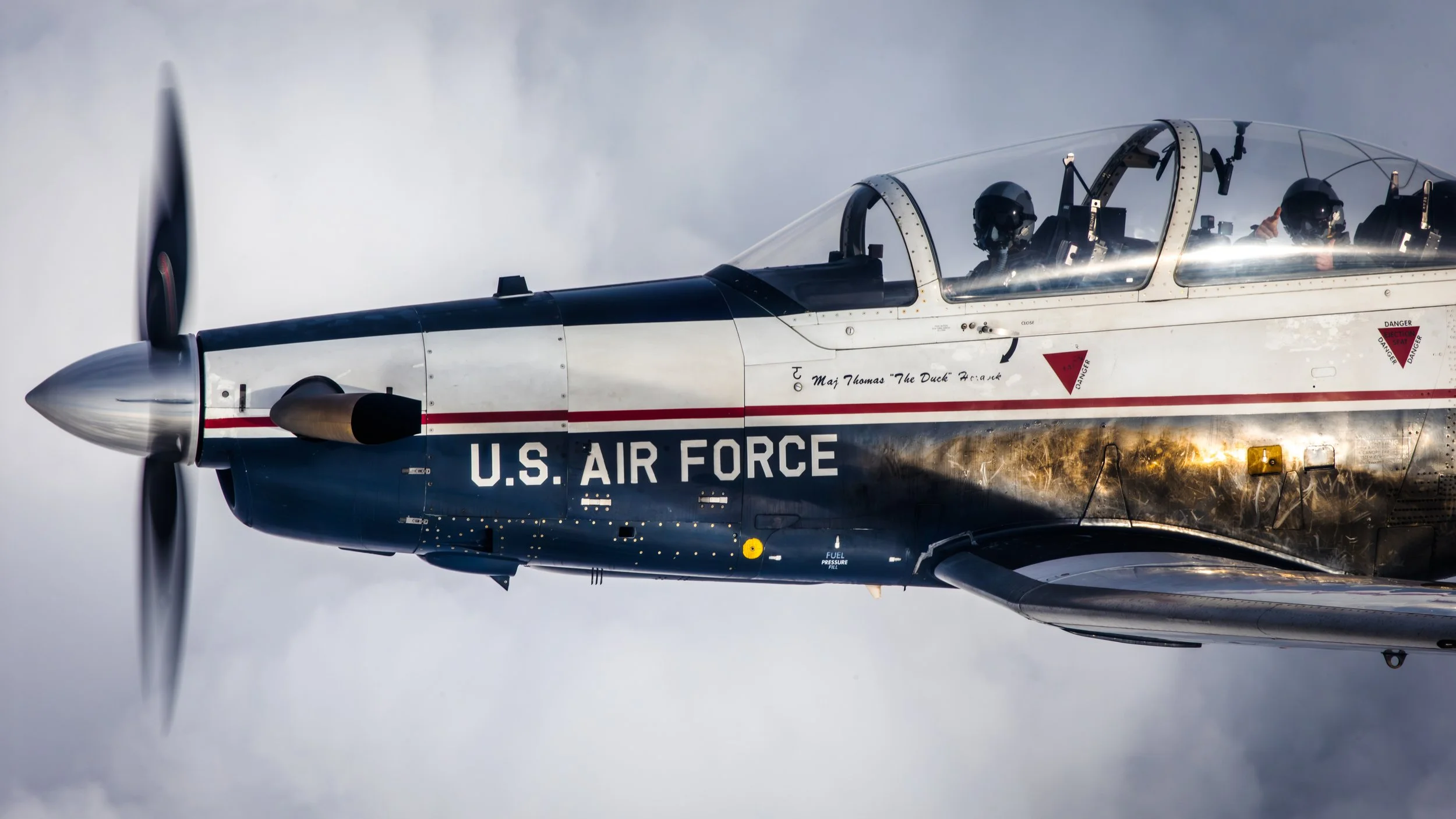
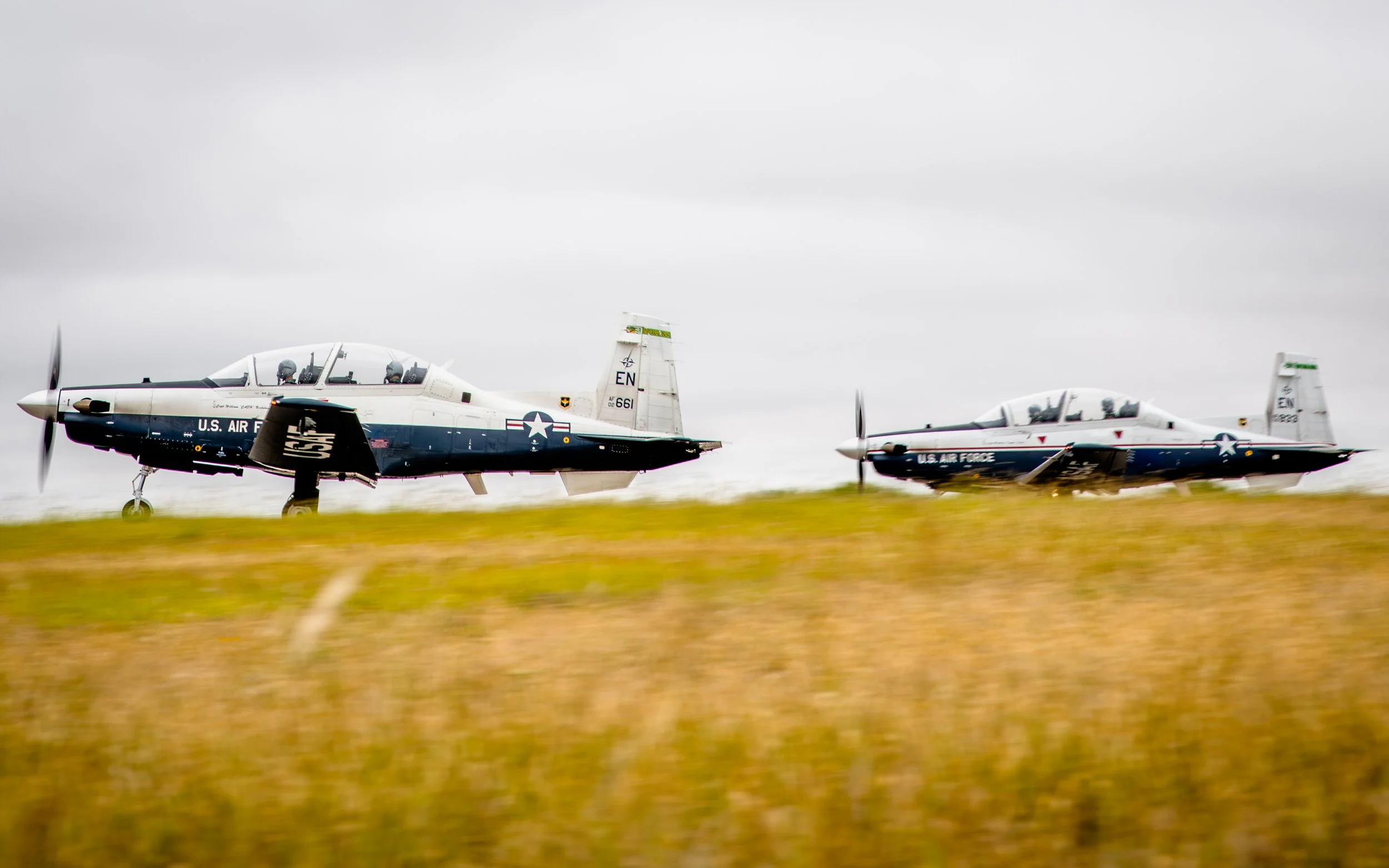
The final stage of our visit offered the opportunity to observe ENJJPT's training philosophy from the cockpit of the Beechcraft T-6 Texan II, the aircraft in which every student begins advanced military flight training.
Although conducted as a familiarisation sortie rather than a syllabus event, the flight provided a valuable opportunity to observe how the principles discussed throughout the previous days—preparation, standardisation and disciplined execution—translate into practical flying.
A Purpose-Built Trainer
The T-6 Texan II occupies a pivotal position within the ENJJPT syllabus.
Powered by a Pratt & Whitney PT6A-68 turboprop engine producing approximately 1,100 shaft horsepower, the aircraft bridges the gap between initial military flying and advanced jet training. While considerably less complex than the fighters students will eventually operate, its cockpit introduces many of the concepts found in modern combat aircraft, including Hands-On Throttle-And-Stick (HOTAS) controls, a Head-Up Display (HUD) and digital avionics.
For students, this provides an early introduction to the workload management and cockpit organisation that will later become essential in aircraft such as the F-16 Fighting Falcon, Eurofighter Typhoon and F-35 Lightning II.
More importantly, the aircraft provides an ideal platform for developing the habits that underpin military flying.
Preparation Before Flight
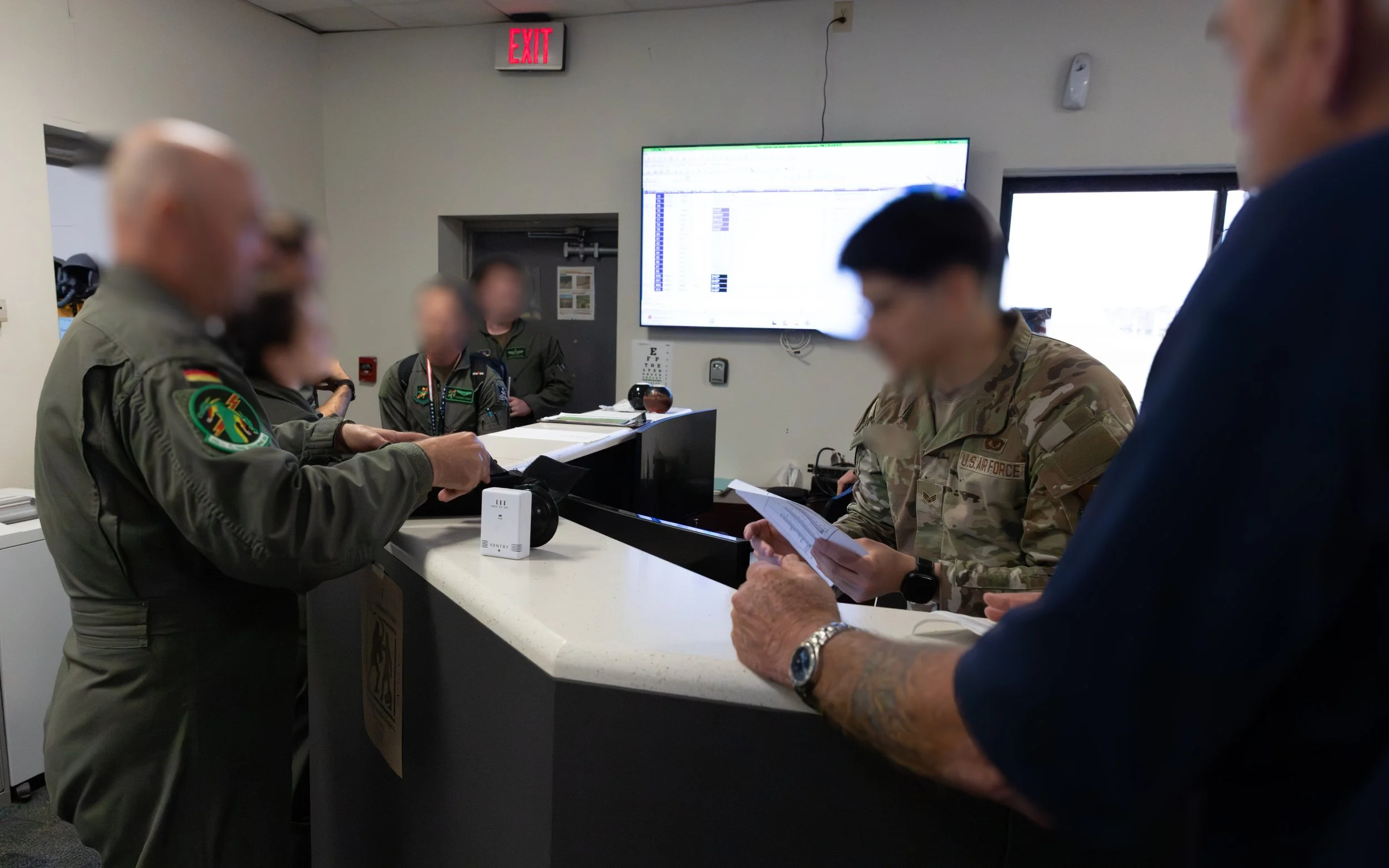
As with every ENJJPT sortie, preparation began well before walking to the aircraft.
The instructor reviewed the mission profile, weather conditions, emergency procedures and planned training objectives before leading a systematic external inspection of the aircraft. Although the sortie differed from a normal student event, the procedures remained unchanged.
That consistency is deliberate.
Throughout our visit, one message had been repeated by commanders, instructors and students alike.
Military aviation relies upon standardisation.
Whether flying with a student, an instructor or a visiting journalist, the same disciplined approach is followed every time. Established procedures reduce workload, minimise the possibility of error and ensure that every crew member shares the same understanding of the mission before the engine is started.
From the Ground to the Training Area
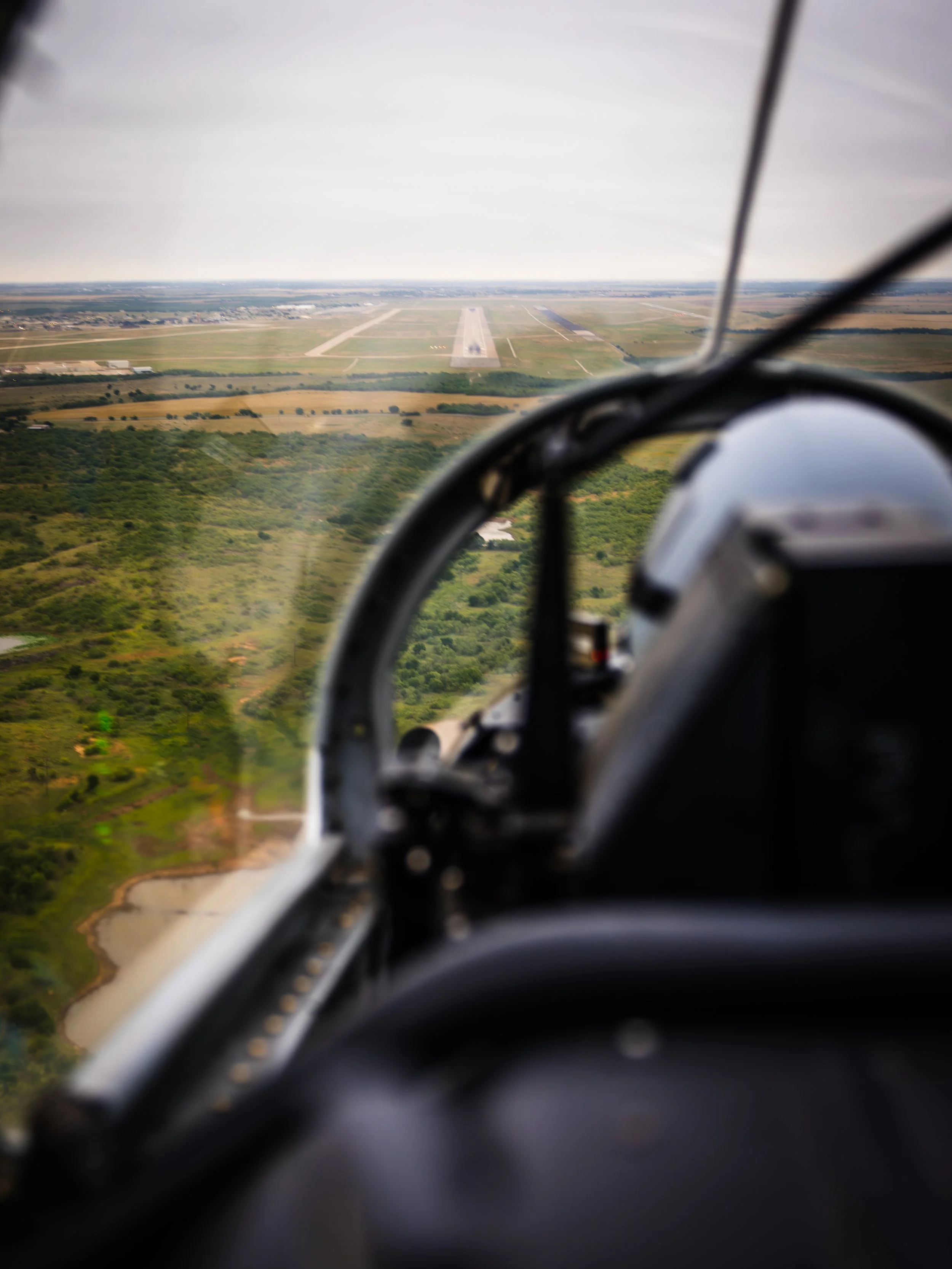
Following engine start, the aircraft taxied towards the active runway before departing Sheppard Air Force Base for the designated military operating area.
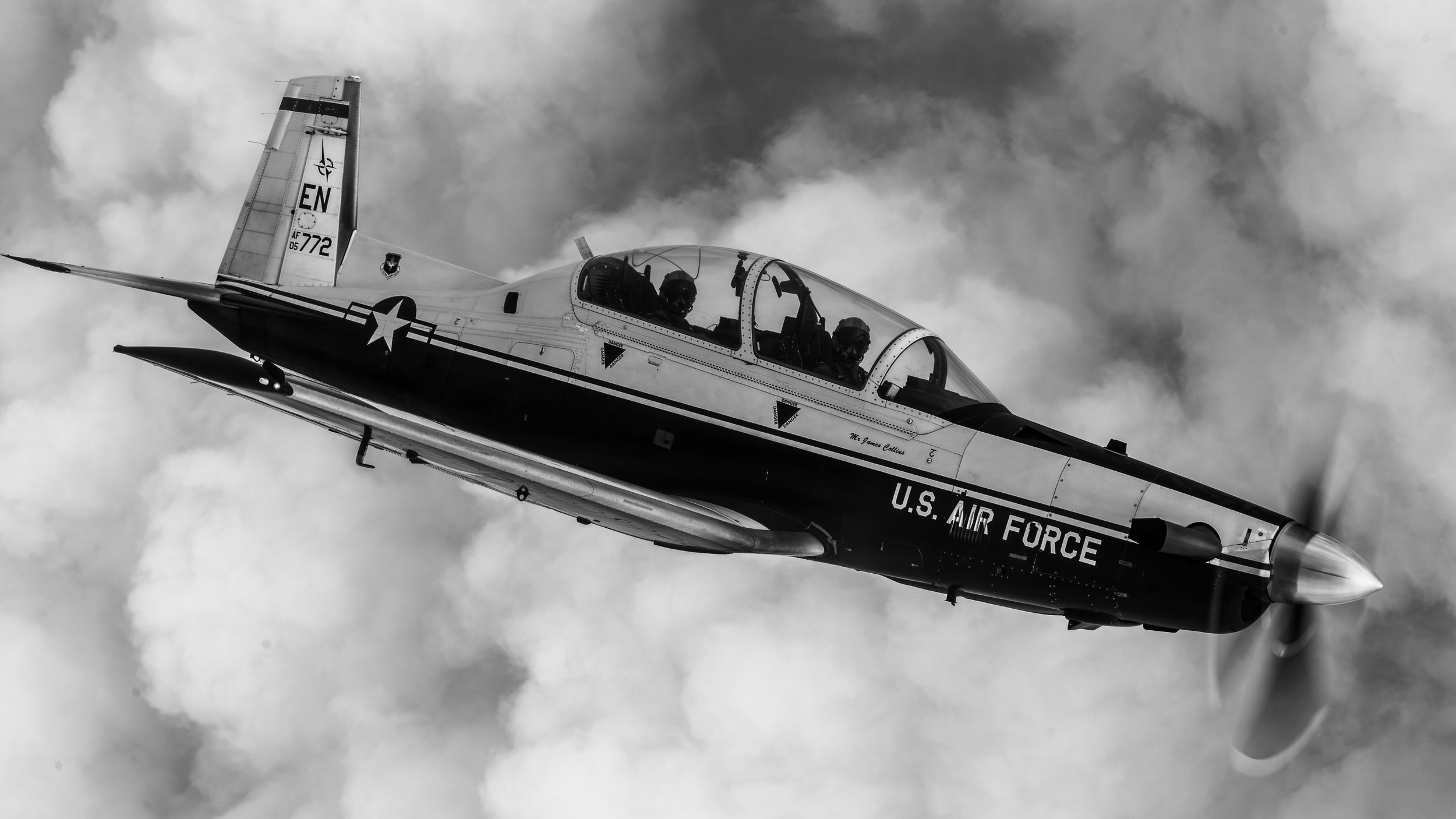
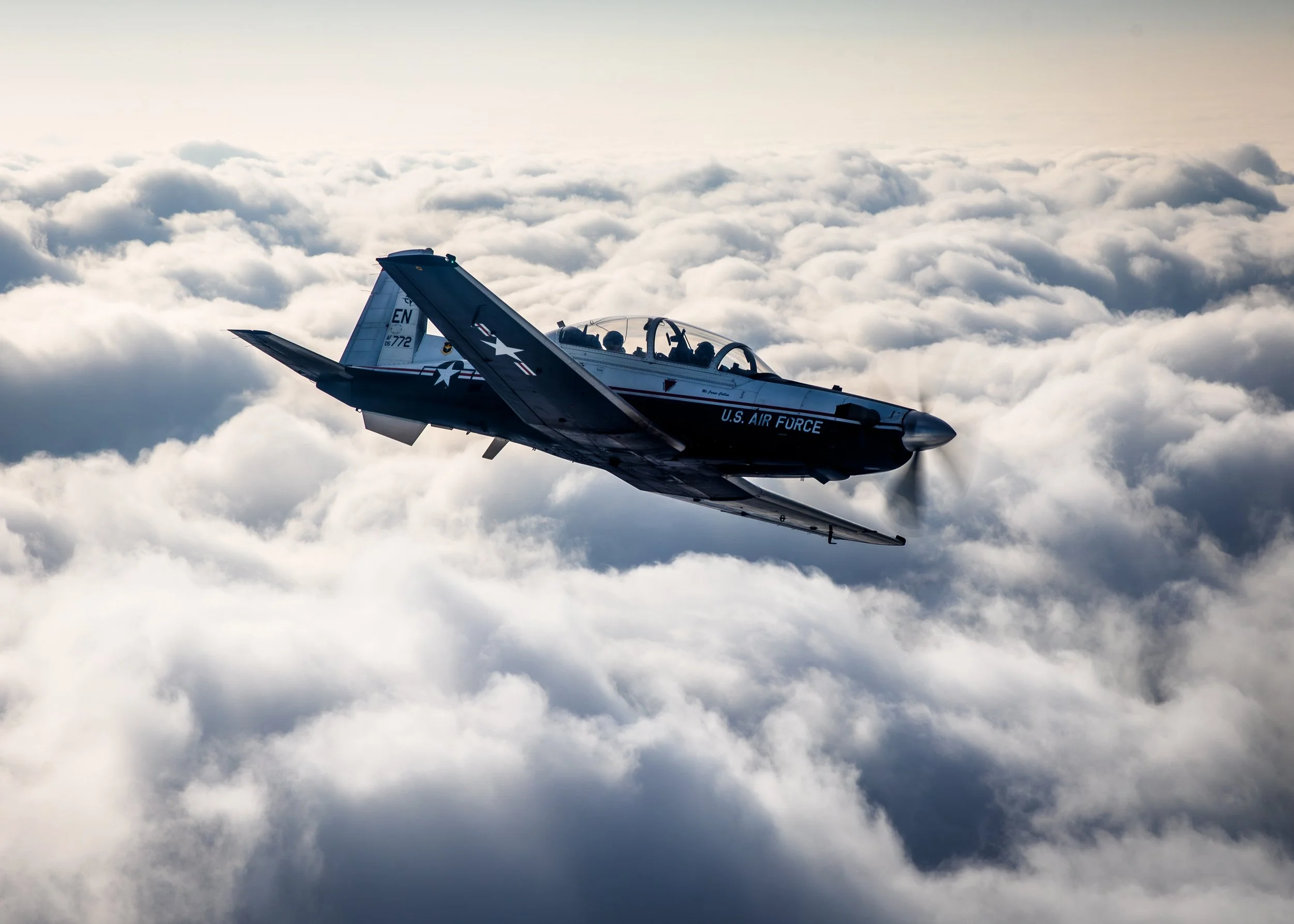
Weather conditions consisted of a solid cloud layer covering much of northern Texas. Shortly after departure, the aircraft entered instrument meteorological conditions before climbing above the overcast into clear air. While visually impressive, the transition also reinforced the importance of instrument flying within the syllabus. Students must learn to maintain accurate aircraft control regardless of external visual conditions, relying upon disciplined instrument scanning whenever outside references are limited.
Above the cloud layer, visibility improved considerably, allowing the planned formation profile to proceed under ideal conditions.
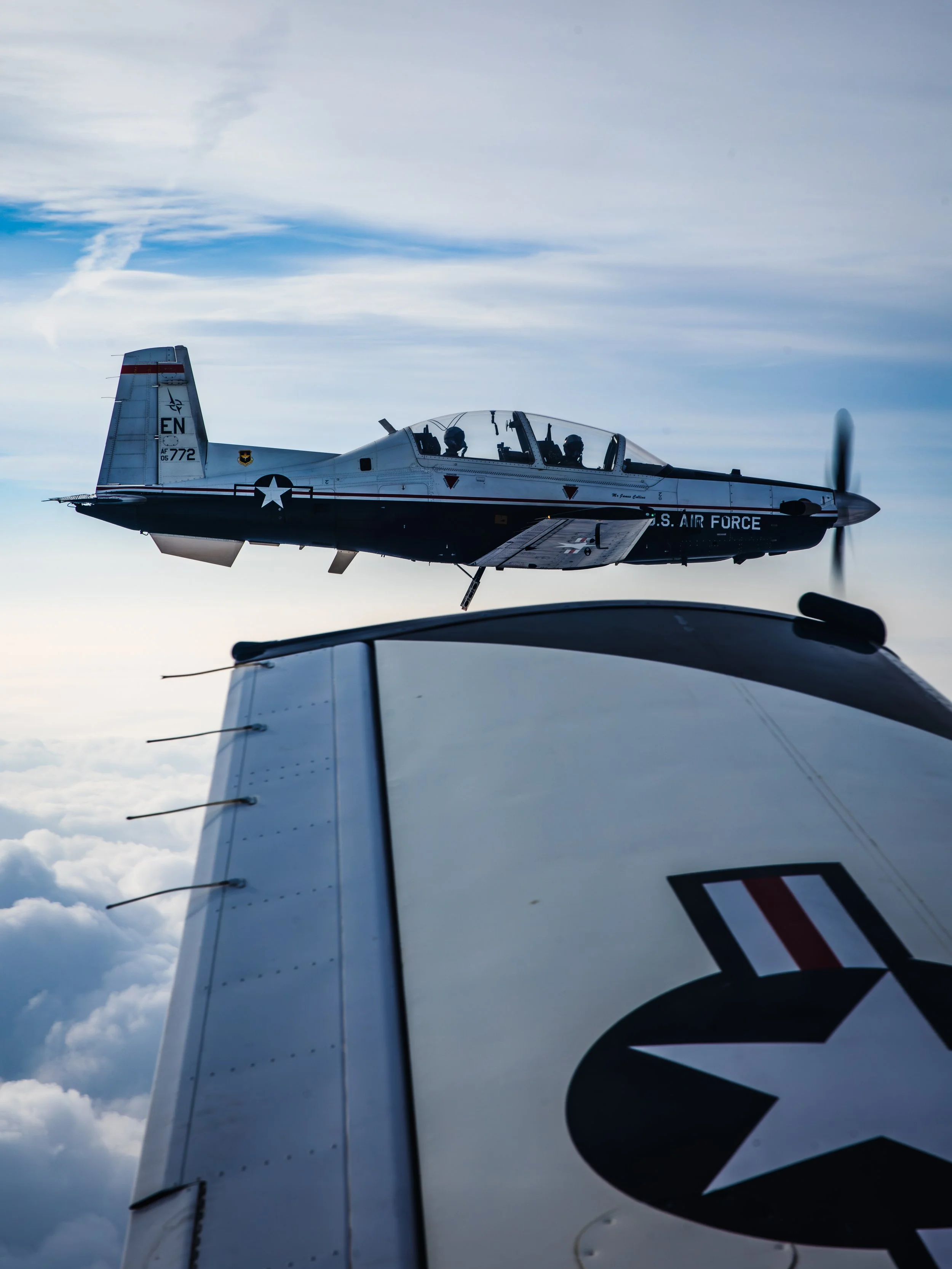
Formation Flying
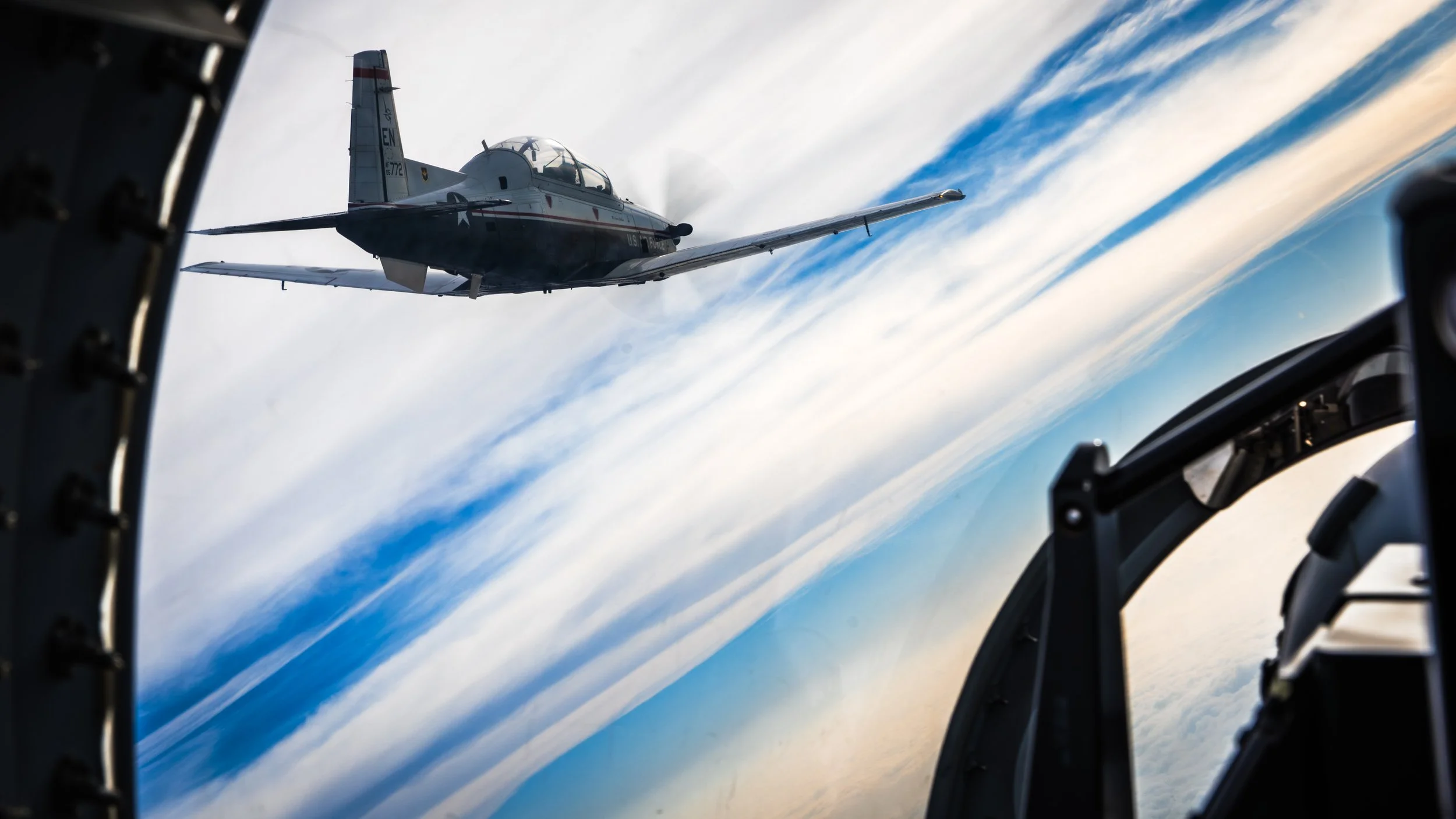
A second T-6 joined in formation to demonstrate one of the fundamental skills developed throughout military flying training.
Formation flying remains central to modern air operations. Whether conducting tactical navigation, air-to-air refuelling, defensive counter-air missions or multinational exercises, fighter aircraft rarely operate independently. Maintaining accurate station therefore becomes a fundamental skill that supports almost every subsequent phase of operational training.
Observing the join highlighted the precision involved.
Rather than making large control inputs, the instructor maintained position through continuous, almost imperceptible adjustments of power and attitude while referencing predetermined points on the lead aircraft. The resulting formation remained remarkably stable, illustrating that effective formation flying depends less upon aggressive manoeuvring than upon anticipation, smooth control inputs and disciplined aircraft handling.
It was a practical demonstration of the instructional philosophy described by Bobby Mitchell only hours earlier.
Confidence developed through repetition.
Precision achieved through discipline.
Workload reduced through preparation.

The Purpose Behind the Flight
While the familiarisation sortie provided a valuable appreciation of the T-6's handling characteristics, its greatest value lay elsewhere.
Over the course of three days, every interview had emphasised that ENJJPT is designed to build competence progressively. Academic instruction provides knowledge. Simulator sessions develop procedural confidence. Flight training integrates those skills within a dynamic operational environment, while structured debriefs ensure that every sortie contributes directly to future improvement.
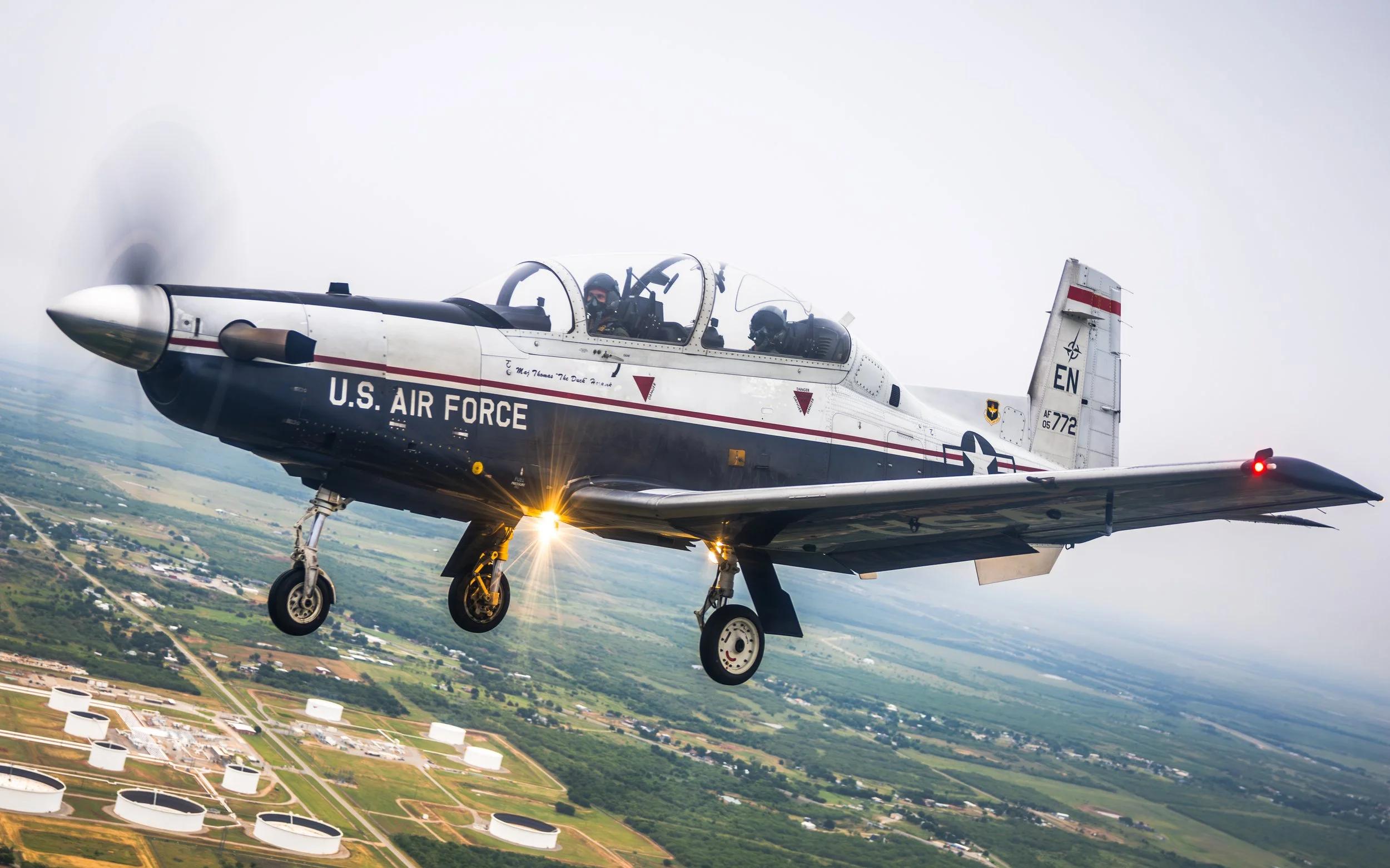
Viewed in that context, the T-6 represents far more than a training aircraft.
It is the platform through which future fighter pilots begin transforming theory into practice.
More Than Flying
Returning to Sheppard Air Force Base, one observation stood out above all others.
Every phase of the sortie reflected the same principles encountered throughout the programme.
Preparation.
Standardisation.
Communication.
Continuous learning.
The aircraft itself was only one component of a much larger system involving instructors, maintainers, operations personnel, life-support specialists and air traffic controllers working together to achieve a common objective.
The familiarisation flight therefore served not as the conclusion of the visit, but as confirmation of everything that had been observed on the ground.
It demonstrated that ENJJPT's greatest strength lies not in a particular aircraft or syllabus event, but in the carefully integrated training system that prepares NATO's future fighter pilots for the demands of operational service.
The future of military aviation will undoubtedly continue to evolve. Aircraft will become increasingly sophisticated, operational environments more complex and technology more deeply integrated into every mission. Throughout those changes, however, the principles underpinning ENJJPT remain remarkably constant—a perspective that Colonel Timo Heimbach believes will continue defining the programme for decades to come.
Preparing for Tomorrow's Air War
Throughout our visit, one question remained at the centre of every discussion.
How do you prepare today's student pilots for an operational environment that will continue to evolve throughout their careers?
For Colonel Timo Heimbach, the answer extends well beyond introducing new aircraft or adopting emerging technologies.
Modern fighter pilots will operate within increasingly interconnected battlespaces where sensor fusion, networked operations and multinational integration play a greater role than ever before. Fifth-generation aircraft have already transformed the way information is collected, shared and employed during combat operations, while future systems promise an even greater degree of connectivity between crewed aircraft, autonomous platforms and command-and-control networks.
Training must evolve accordingly.
Yet, despite these technological advances, Colonel Heimbach emphasised that the qualities expected of military aviators remain remarkably consistent. Leadership, sound judgement, adaptability and disciplined decision-making continue to underpin operational success regardless of the aircraft being flown. Technology enhances capability, but it does not replace the individual responsible for employing it.
That philosophy explains why ENJJPT places such strong emphasis on developing officers rather than simply producing pilots.
Every stage of the syllabus—from classroom instruction and simulator events to flying training and structured debriefs—is designed to cultivate the habits, mindset and professionalism expected throughout a military aviation career. Aircraft types will inevitably change, but the ability to analyse information, manage workload and make sound decisions under pressure remains fundamental.
Future developments, including the continued introduction of fifth-generation fighters and the eventual arrival of platforms such as the Boeing–Saab T-7A Red Hawk, will naturally influence how military pilot training is delivered. ENJJPT will continue adapting to those changes, just as it has throughout its history.
Its purpose, however, remains unchanged.
To prepare allied officers capable of operating confidently, safely and effectively within the increasingly complex environment of NATO air operations.
More Than a Flying School
Over three days at Sheppard Air Force Base, one conclusion became increasingly clear.
The Euro-NATO Joint Jet Pilot Training Program is not simply a place where students learn to fly military aircraft.
It is where they learn how to become military aviators.
Every aspect of the programme contributes to that objective. Academic instruction develops technical understanding. Simulators build confidence and decision-making. Flight training refines aircraft handling. Structured debriefs encourage honest self-assessment, while the multinational environment exposes students to the cooperation and standardisation that define modern NATO air operations.
Viewed individually, each element appears straightforward.
Together, they form a training system that has prepared thousands of fighter pilots for more than four decades.
Perhaps ENJJPT's greatest achievement is not measured by the number of graduates it has produced, but by the common professional culture it has established across the Alliance.
Students arrive representing different nations, different military traditions and different operational ambitions.
They graduate having trained to the same demanding standards, using common procedures and sharing an understanding of military aviation that extends beyond national boundaries.
Many will meet again years later.
Some during multinational exercises.
Others during NATO Air Policing missions, coalition deployments or operational combat assignments.
By then, they may wear different uniforms and fly different aircraft, but they will draw upon the same principles first developed during their time at Sheppard Air Force Base.
That continuity is what makes ENJJPT unique.
It is not simply producing qualified pilots.
It is strengthening NATO's ability to operate as a truly integrated air force.
For visitors, observing that process offers a valuable reminder that successful military aviation depends upon far more than advanced aircraft. Behind every sortie stands an organisation built upon preparation, discipline, cooperation and the commitment of the instructors, maintainers, controllers and students who dedicate themselves to the next generation of Allied airpower.
It is a responsibility the Euro-NATO Joint Jet Pilot Training Program has fulfilled for more than forty years—and one it is clearly prepared to carry into the future.
Acknowledgements
Steel Wing Stories extends its sincere gratitude to the Public Affairs Office of the 80th Flying Training Wing, Cpt. Elizabeth Notice and 2nd Lt. Dennis Melka for their professionalism, hospitality and invaluable support in making this visit possible. Their careful planning, coordination and willingness to provide exceptional access throughout our time at Sheppard Air Force Base made it possible to gain a genuine understanding of the Euro-NATO Joint Jet Pilot Training Program and, above all, the people whose dedication sustains it every day.
Special thanks are extended to Colonel Timo Heimbach for sharing his strategic vision for ENJJPT and NATO airpower, Instructor Pilot 1st Lt. Bobby Mitchell for providing an insightful perspective on military flight instruction, the Air Traffic Control team for explaining the complexities of supporting one of the busiest military training environments in the United States, and Student Pilot 2nd Lt. Jaxon Willis for offering an honest and engaging account of life as an ENJJPT student.
Our appreciation also goes to the instructors, maintainers, operations personnel, life-support specialists and every member of the 80th Flying Training Wing whose professionalism ensures that future NATO fighter pilots receive world-class training. Their commitment extends well beyond flying instruction. Every sortie reflects the collective effort of a team dedicated to strengthening the interoperability, cooperation and operational readiness of the Alliance.
Without the support of the Public Affairs Office and every individual who generously shared their time, expertise and experience, this article would not have been possible.